I train people every month. I receive resumes every month. The old resume models are done. The ‘job’ of ‘finding a job’ is a function of AI sophistication.
It’s time to get sophisticated.
The Verification Issue… to Revolution?
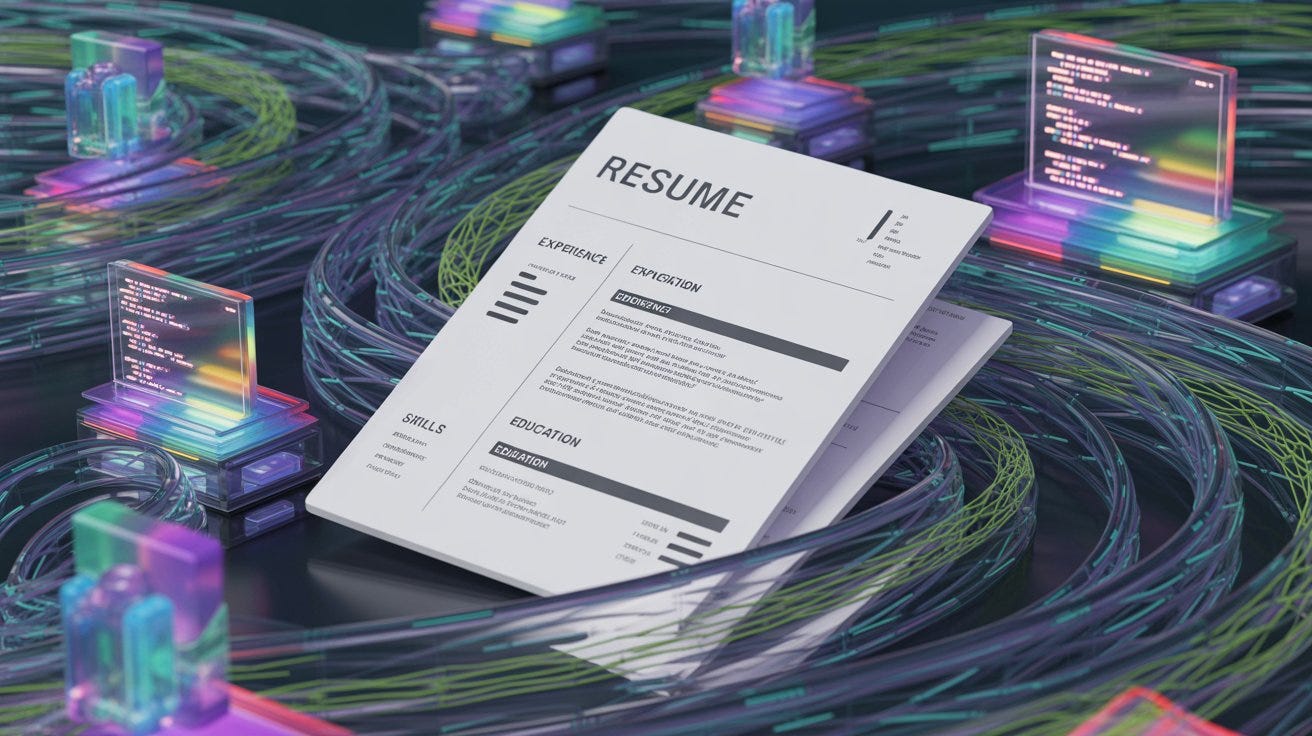
The AI job market is experiencing a profound collapse in hiring signals because the marginal cost of information production has fallen to zero. Before 2022, signals (like a well-written resume or cover letter) were expensive to produce, which separated “signal from noise.” Now, with Large Language Models (LLMs), anyone can produce 10 custom, high-quality resumes at zero cost, destroying the informational value of these credentials.
This new environment is characterized by a cacophony of noise. Traditional advice—to yell louder by optimizing portfolios or social media presence—only adds to the problem. The information equilibrium that existed before 2022 is permanently gone.
5 Principles for Verification in the Post-AI Era
The solution is to pivot from credentialing (the old game of certifications and resumes) to verification, which shows skill in a provable way. These are five principles that I believe allow you to stay above the fray:
1. Process Over Outcome - LLMs easily fake outcomes (code, writeups, demos). Instead, focus on demonstrating your process—the iteration cycles, where you got stuck, how you debugged, and what you would do differently. An effective portfolio should tell a full story, including honest accounts of mistakes and failed designs. - I wrote a book on how to start your brand with video. Video (does) help.
2. Make Verification Easier - The goal is not to have a “better” resume; companies are drowning in candidates but can’t tell “who’s real.” The ultimate winner in this system is the one who makes the hiring decision the easiest.
Actionable Steps: Offer verifiable proof, such as conducting live problem-solving videos or demonstrating real-world solutions through work trials.
Social Proof: This comes through social media. Is your social media helping your career aspirations? Should it?
3. Use LLMs to Generate Signal, Not Just Noise - Currently, LLMs are primarily used as noise generators (e.g., creating cheap text for applications). We should instead use them creatively as verifiers, evaluators, and researchers.
Creative Examples: Use an LLM to generate an adaptive competence assessment that progressively tests your capabilities until your “competent ceiling” is found. You can also show your prompt quality and iteration patterns through cryptographically signed LLM conversations (or simply demonstrating the process).
AI to edit resume?: This may seem like Captain Obvious, but you should throw it through GoogleLM and ask questions.
4. Bilateral Value Creation - Help companies clarify what they actually need. Many companies are posting fuzzy, LLM-generated job descriptions. By offering analyses of their challenges, interviewing them about the problem space, or proposing trials that validate their needs, you help them gain clarity. This type of value production reminds the company that you offer something beyond what a simple LLM or ChatGPT can provide.
5. Capability Spaces Over Job Titles - Job titles are often noise because roles are evolving too quickly. Instead of focusing on titles like “AIPM,” think in terms of specific, verifiable capability sets, such as:
Technical communication.
System design under situations of uncertainty.
LLM evaluation.
Rapid prototyping. Position yourself across these capability spaces and demonstrate your process by matching on the types of problems the company needs solved. This transcends the keyword-based matching game that still dominates the job ecosystem.
The core problem companies face is vetting, and the advantage goes to those who make vetting easier. As LLMs make information free, verification becomes priceless. By shifting your focus to process transparency and demonstrable capabilities, you are building toward the future hiring system that will replace the permanently broken old one.
The more multi-faceted you show yourself to be, the more useful you appear.
Once again, being deeply useful to everyone is pretty much the V-shaped full stack human I’ve talked about a lot in the past.
We must evolve to survive. Resumes are the placard.
All the best,
ps
—
Oh, and in 3 days the FutureTech Forum focused on AI and the job market is happening. I’ll see you there.