Case Study · Agile Transformation · Strategy Retreats · AI Enablement
Two retreats. Six teams. One heartbeat.
A thirty-person, remote-first real-estate data organization spread across nine time zones. Five years into agile, sixty-eight initiatives on the backlog, planning that didn’t hold, and a CEO who asked for real coaching, not another framework. What followed was ninety days of weekly, in-the-room strategic consulting: two leadership retreats designed and facilitated — the annual all-hands and the board’s strategy day; the 2027 strategic direction shaped with the board; every team’s cadence redesigned around one leadership heartbeat; team leads and individuals coached one to one; and all of it carried through a CEO transition.
What this engagement was
Three things we do, all three in ninety days.
Leadership strategy retreats
Two in five weeks. The all-hands, co-designed from June, where the agenda handed us four blocks of the day. Then the board’s strategy day: a World Café for the whole company in the morning, futurecasting with the board in the afternoon, the executive debrief the next morning.
The two retreats ↓Strategy through mergers, acquisitions and transitions
An operating model moved from entrenched agile into the age of AI. A board conversation about the questions that decide the next five years: what to spin out, whom to join forces with, who should own what. And a CEO transition mid-engagement that we steadied rather than used. Peter has five exits of his own.
Through the transition ↓Coaching teams to productivity
Twelve weeks inside every team’s planning, refinement, retro and review. A diagnosis in their own words. A heartbeat model with team-chosen cadences and real KPIs. Working agreements the room signed. Team leads and individuals coached one to one.
Six teams, one heartbeat ↓The company
Strong company, fragmented week.
Not a turnaround. A profitable, respected organization with recent industry awards, a technical team already deep in AI-assisted development, and a CEO who could name the problem out loud: decisions felt top-down, and the work felt fragmented. Thirty people in nine time zones will do that. Every agreement has to survive a twelve-hour gap, and most of them didn’t.
Agile had been installed five years earlier and had done its job: the ship was out of port. But the prescription had been applied to every team the same way, and the teams whose work isn’t software — communications, partnerships, support, data — were force-fitting their world into sprints, complexity points and story cards that were never built for it. Sixty-eight initiatives sat on the product backlog. Planning was weak, work in progress was everywhere, and the certifications in the room were not the problem.
The ask, in the leadership’s words: team agile training and certification, facilitate the strategic-planning day, harden the org chart, and get a handle on the work in progress. The brief, said in front of the whole company: real coaching and human connection, not another framework.
What we saw first
Agreements on paper. Nothing holding them.
We didn’t open with a workshop. We opened as a fly on the wall: six weeks of cycle planning, executive roadmapping, sprint planning, backlog refinement, retrospectives and sprint reviews across every team, with the camera on and the mouth mostly shut. The pattern was the same at every altitude.
One disease, three symptoms: agreements existed on paper; nothing enforced them; a few patient people were the compensating mechanism. And the part that mattered most: the organization had already said this about itself. We didn’t need to sell the diagnosis. We needed to help them act on it, in their own vocabulary, without adding to anyone’s load. The company had just published its values, drafted from staff words, and two of them were almost literally the fix: planning that feels expected rather than confrontational, and measuring what’s said against what’s done. Every move we made was retagged in those words. No Scrum sermon, no Kanban sermon, no transformation program.
Retreat 1 · August · the all-hands
Designed from June. Carried on the day.
In June, before the engagement had paper, we offered the leadership team four formats for their one in-person day of the year: a World Café, a multi-team agile exercise, a hands-on AI workshop, and a talk. They took all four and built the day around them. By the time the planning committee’s near-final agenda arrived, four of the day’s blocks had our name on them:
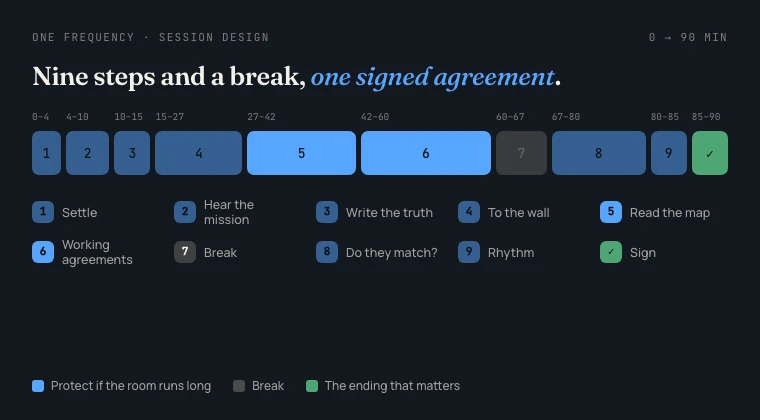
One Frequency is nine steps and a break. No slides to open with; lights down and two slow breaths instead. The mission read aloud, slowly, twice, with silence between — not analyzed, felt. One honest word from everyone, anonymously, posted and clustered live on the wall. The positive cluster is the guiding star: what “good” feels like here. The negative cluster is data, not complaints: each one points at the exact place the mission and the lived week don’t match yet. Then each team writes the promises that protect the good side of the wall, and names the constraints in its way.
Bright segments are the two to protect if the room runs long. Green is the ending that matters: the overlap across teams harvested into one enterprise agreement — read aloud together, a name against each promise, signed, and hung next to the mission.
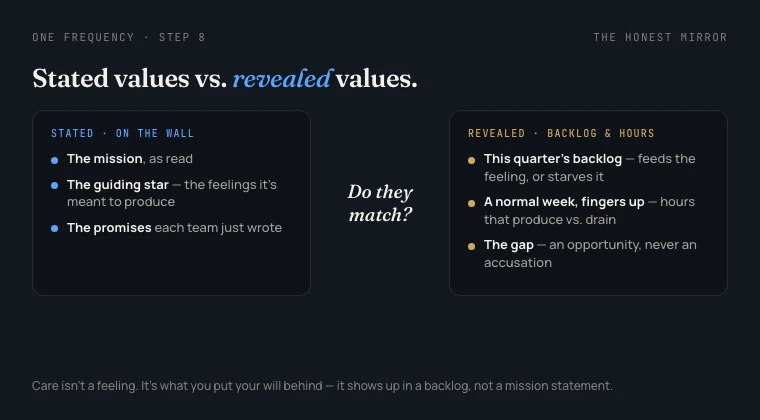
Stated · on the wall
- The mission, as read
- The guiding star — the feelings it’s meant to produce
- The promises each team just wrote
Revealed · in the backlog & the hours
- This quarter’s backlog — which items feed the feeling, which starve it
- A normal week, fingers up — hours that produce the good feeling vs. hours that drain it
- The gap — an opportunity, never an accusation
The week around it mattered as much as the day: the staff-and-board social the night before, one-on-ones from the executive team down to the newest analyst, and, two days later, a written retro to the CEO: agile is installed and the ship is out of port; the “how” had been more prescriptive than each team needed; the working agreements need real paper and signatures to come alive; and the two non-software teams needed breathing room to understand the why before being handed another how. The to-do list that followed was short and specific: time with the team leads alone, and a version of agile each team could call its own.
Retreat 2 · September · the board’s strategy day
His content. Our frame.
Two weeks out, the CEO shared the strategic-planning deck and his speaker notes and asked for “any insider nuance.” We reviewed the final deck with the executive team the afternoon before and wrote our own facilitator notes: the arc of the day, the questions to hold, where the pivot was, which table carried the most signal, and the one insight to use sparingly, once, well. Posture: light. His state of the union; our structure, our facilitation, our futurecasting.
Nearly thirty people in the room — board, the stakeholder associations that own the company, and staff. The morning opened with the CEO’s core question: four co-equal objectives, or one north star and three enabling constraints? Then a World Café we facilitated: five tables, one per objective plus a wildcard for new priorities and emerging risks, groups rotating, every table leaving its thinking behind for the next, convergence harvested at the end. The same discipline as the all-hands: we notice and name; we don’t author.
The afternoon was board and executives only, and it was ours: futurecasting. Six questions about the next five years — which products to spin out or keep, whether to pool data with peers, what the ownership and board structure should be, how to license what the company owns. A temperature-check vote across all six, the deep dive on the one with the most energy, and the other five dated as agenda items rather than dropped. The frame we set: these aren’t decisions today. They’re the questions that decide 2031. Where the question touched ownership, we held it strictly neutral: facilitate, never opine.
Two questions we carried in reserve and asked once, neutrally: if these three objectives are constraints, which one is the constraint right now? And what’s the one number that tells us we’re growing, not just getting leaner? The next morning the executive team met to digest the day with us in the room. A week later the CEO’s first draft of the 2027 strategic direction came back to us for suggestions, feeding the October board and the November budget. One board-room attendee wrote the next day to ask for the same session for her own team.
The operating model
Six teams, one heartbeat.
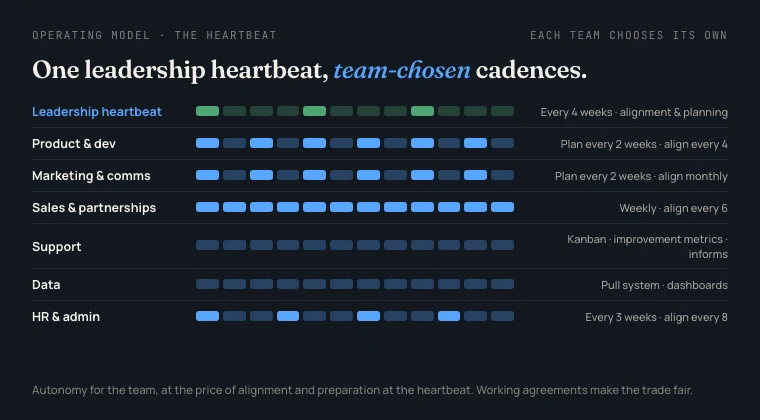
Five days after the all-hands, the whole executive team received a written operating model. The thesis: agile is installed; the “why” behind the “what” is missing in places; each team now needs a cadence it truly chooses itself, with real KPIs both the team and leadership agree to, matched to one core heartbeat of leadership planning. Remove complexity: move each team’s work from the unknowable to the documented to the repeatable. Feelings became working agreements (how we do together) became constraint identification (how we work with others). Now KPIs per cycle, per team, on whatever cadence lets that team come up for air and align as a whole.
The trade, stated plainly to leadership: a team gets the autonomy and freedom it wants, at the cost of organizational alignment and the discipline to show up super prepared at the heartbeat. Working agreements and roommate agreements are what make the trade fair.
A month later, after the fly-on-the-wall review of every team meeting and its permutations was complete, the plan for the last quarter put the heartbeat to work as a funnel, up and down:
The AI-enablement thread ran underneath all of it. The CEO’s own product planning was already coalescing into a durable sequence with an AI assistant, and the engineering team was deep in AI-assisted development. The operating model was built for that world: five years of entrenched agile, decomposed for the age of AI — fewer complexity points, less story-card ceremony, more flow, a heartbeat that gets instrumented rather than administered, and hiring and roles considered for an AI-enabled company. Every sprint is just an experiment, iterating until consistent delivery is normal and the margin for growth, learning and science increases.
Coaching
Inside every ceremony, then one to one.
Twelve weeks in the rooms where the work is planned
Cycle planning for all teams and product owners. Executive roadmapping. Sprint planning for support and data. Backlog refinement for the support leads, the data team and communications & partnerships. The dev team’s refinement and retro. Biweekly retrospectives. Sprint reviews. The operations standup. The Wednesday executive meeting. Mondays and Tuesdays, every week.
✓ Six teams, every ceremonyA diagnosis in their words, then a model they could choose
The retro to the CEO, the operating-model memo to the executive team, the last-quarter plan: three written documents, each small, each in the company’s own published vocabulary. Teams currently in flight were never told to stop; the observable consternation from force-fitting was named, and leadership chose the timing.
Team leads, one to one
The non-software teams had swallowed a prescription of agile that “just worked” and were finding friction. Rather than coach through the agile leads, where relational baggage could make a team less receptive, we asked the CEO for the list of leads and met them alone: their world, from their mouth, instead of only observing. Fit and form per team.
✓ Their version of agileIndividuals, one to one
At the all-hands white elephant, one analyst swiped an hour of coaching and asked for career and life direction rather than Scrum. The hour became a written set of notes, a follow-up a month later, and, in their words, “hard truths,” “a-ha moments,” and a one-, two- and five-year plan written that weekend.
✓ A five-year plan, writtenCertification and training, in scope
Product-owner certification for staff was part of the engagement from the first scoping call. Peter has been a Scrum Alliance Certified Scrum Trainer since 2009; his classes are team-based activities, not slides, so people do the thing rather than hear about it.
Protected the people holding it together
Every proposed change was tested against one rule: does it reduce the load on the people compensating by hand? Nothing that added a meeting survived. A system problem was never allowed to become a person problem.
The transition
When the CEO moved on, the frame held.
Ten days after the strategy day, the CEO who had sponsored the work moved on. The posture changed the same afternoon: stability and continuity — listen, steady, stay small, take no side. The team meetings continued. The interim leadership, a finance chief stepping up and the longest-tenured executive as operating lead, got a short written note rather than a proposal: take the time to find the right CEO, no rush; the gap is the executives’ chance to set the new reality and raise their own authority; a quarterly planning cadence with the engineering lead’s rule of one project planned, one executing, one wrapping up is exactly right for the constraints; and we can help on two fronts, the organization’s structure, cadence and heartbeat with leadership, and cadence, expectations and alignment with the teams.
At the October retrospective with both agile leads, the teams had already transcribed their own all-hands boards into a written synthesis, and it landed where our July notes had: the commitments between colleagues were real; what stood in the way was structural — priorities, intake, capacity. Working rules were set for the next phase: we work only with team leads who can decide; leads source their own teams; the framework starts from the boards the company already wrote. Interim leadership then chose to close the engagement in November. Because every artifact was the teams’ own, nothing left with anyone.
What exists
The results, labeled.
No lift is claimed on this page. We didn’t baseline a metric, so we won’t invent one. What follows is what exists, and who owns it.
Why it’s built this way
Watch before you speak
Weeks inside the real planning rooms before a single recommendation. The diagnosis is written in the company’s own vocabulary, and only after they have, in effect, written it themselves.
Notice and name; never author
In a retreat, we harvest the convergence. The room writes the agreement, the board picks the question, the teams choose the cadence. It holds because nobody can say a consultant wrote it.
Ask, don’t assert
The whole toolkit is questions: which one is the constraint? What’s the one number that says we’re growing? Whose voice haven’t we heard? Asked once, neutrally, and the room does the rest.
Autonomy, traded fairly
Teams get the freedom they want at the price of alignment and preparation at the heartbeat. Working agreements make the trade fair. If it needs a new tool, it’s too big.
What you get
What a transformation engagement with retreats ships — a room that decided, not a binder.
- Retreat design and facilitation — the all-hands and the board’s strategy day, from June concepts to the harvested room
- Strategy-day preparation — deck review, facilitator notes, the questions to hold, the one insight to use once
- Facilitated futurecasting — the questions that decide the next five years, voted, deep-dived, dated
- An operating model in writing — leadership heartbeat, team-chosen cadences, KPIs per team, the funnel up and down
- Working agreements the room signs — One Frequency, ninety minutes, nine steps and a break
- Coaching at three levels — executive, team lead, individual; plus Scrum Alliance certification training
- Transition support — when leadership changes, a steadying note, not a proposal
- Honest labels — what we observed, what you decided, and what nobody measured

Representative artifacts — the session design and operating model we ran, redrawn without client identifiers, plus a dashboard from our 44-dashboard marketplace. Your versions get built on your ceremonies.
See where you stand
Name the thing your team keeps re-solving. Find where the same shape repeats. Leave with one test you could fail this week.
A retreat to run, a transition to steer, or teams that need to ship?
We design and facilitate leadership strategy retreats, hold the frame through mergers, acquisitions and leadership change, and coach teams to a cadence they choose and keep. We sit in your meetings first. Then we tune the instrument you already have, in one room, and hand it back signed.
Start a conversation More case studies