People are always surprised that my son and myself don’t watch F1. “But you’re all about racing,” they say. Yes. Racing.
Yes… Racing.
Formula 1 isn’t a motor vehicle race. It is actually rockets on 4 wheels going fast on a track and at knowable-moments, pass their fellow competitors.
In F1, they rarely race.
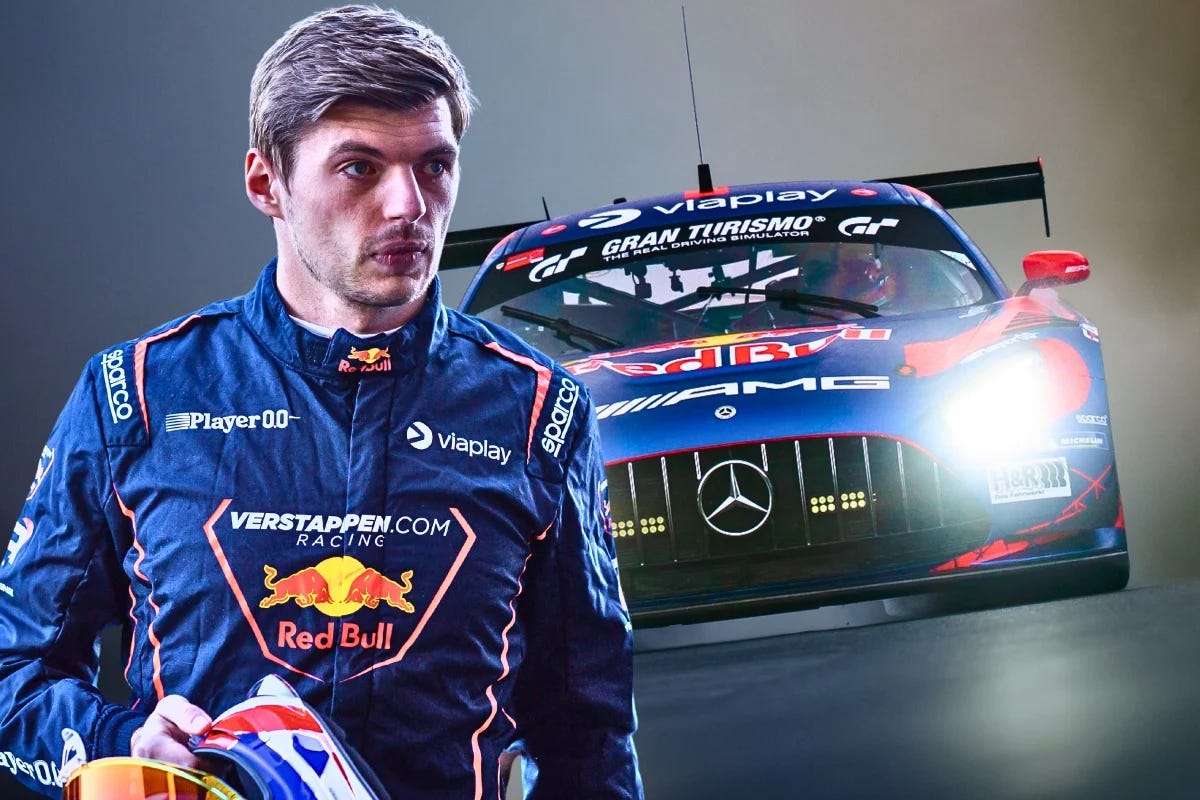
The biggest story in motorsport this year didn’t happen on the high-gloss streets of Miami. Instead, it unfolded in the middle of a German forest, where Max Verstappen escaped the Formula 1 bubble to remind the world what raw racing actually looks like.
To my uninitiated racing readers, Max Verstappen is the Michael Jordan of racing. Once-in-a-life-time phenom. Give him any engine, four wheels, and a steering wheel and he will be fighting you for the win. 4x F1 Champ and imho The Goat (with more to give).
While F1 was busy polishing its corporate image, their own world champion was accidentally embarrassing the sport by participating in the Nürburgring 24 Hours… and wiping the floor.
The Return of “Old School” Commitment
Max didn’t use celebrity shortcuts or VIP passes to get there. My son and I tracked his entire journey: he sat through the theory exams, raced the qualifying rounds, and earned his Nürburgring permit exactly like every other driver.
This stood in stark contrast to the modern F1 driver, who often feels like a media-trained corporate asset rather than a racer. In fact, the scary part for F1 is that almost no other driver on the grid is even allowed to do this. While Red Bull lets “Max be Max,” reports indicate that teams like Mercedes have blocked drivers like George Russell from even attempting Nürburgring licenses due to risk management and brand protection.
The Technical Masterclass: Better Than the Pros
Critics initially claimed Max couldn’t simply jump into a GT3 car and beat specialists who had spent years mastering the machinery. They were wrong. When the data from the Winward Mercedes emerged, the results were uncomfortable:
Pure Pace: Max was over a minute faster than factory pros across equivalent stints… we were tracking.
Dominance: He set the fastest lap of every Winward driver and accounted for nearly half of the car’s total fastest laps. He dominated.
Raw Instinct: Footage captured Max overtaking at over 200 km/h with two wheels on wet grass, followed by a door-to-door battle at 2 a.m. with Maro Engel through heavy traffic… my son and I watched it live and exclaimed aloud at how dangerous it was…
For the first time in years, we could actually see the hands behind the wheel making the difference, a master at his craft. Executing flawlessly. It was pure.
F1’s Corporate Sterilization and Costs
The Nürburgring weekend highlighted a growing rift between F1’s business model and its fan base. The sport has moved toward a “rights first, fans last” mentality, evidenced by the sudden geoblocking of the Nürburgring stream for North American viewers. VPN baby.
Furthermore, the accessibility to the normal motorsports fan is becoming a financial constraint. F1 is a great show with celebrities and music and pomp and circumstance. You’re paying for the show.
Global Viewership: Overall viewership has reportedly dropped by over 40%.
Regional Declines: In Germany—once a primary hub for the sport—viewership has fallen by 21%.
Subscription Cancellations: In a span of the beginning of 2026, more than 35,000 fans cancelled their F1 TV subscriptions.
Social Media Sentiment: When fans voiced concerns online, the FIA reportedly censored over 1,000 non-abusive comments directly…
Formula 1 is now standing at a crossroads. Other major races are already moving in to grab more Max because he brings the fans with real racing:
Bathurst 12 Hour organizers are reportedly targeting Verstappen for 2027.
Ford Performance has confirmed conversations regarding future Le Mans Hypercar opportunities.
Le Mans, Daytona, and Spa are starting to look like “unfinished chapters” for Max rather than post-career bucket list items.
The Reckoning and the Opportunity
The Nürburgring 24H proved that Max’s popularity no longer depends on Formula 1. If the face of the category is already emotionally looking beyond the sport, the fans may eventually follow him there.
Fans have now seen something they can’t unsee: the best driver in the world racing without mediation, corporate polish, or restrictions. If F1 doesn’t bring the driver back to the center of the sport, it may find that its 30-year loyalists, some of whom are already calling the current era an “obituary” for the sport, will continue to move on to where the racing is real.
For the opportunist, it sounds like a business idea.
All the best,
ps