Saddington is an English locative surname of Anglo-Saxon origin.
Derived from the village of Saddington in South Leicestershire, England.
First recorded in the Domesday Book of 1086 as "Sadintone" (place-name) and "Godwin" (tenant).
Earliest recorded bearer of the surname: William de Sadington, 1284.
~1,936 living Saddingtons worldwide today (Forebears 2014); ~4,641 lifetime bearers ever recorded (Saddington One-Name Study estimate).
Most prominent historical Saddington: Sir Robert de Sadington, Lord Chancellor of England 1343–1345.
Most prominent living Saddington (by search dominance): Peter Saddington (b. 1982, Wikidata Q138786050), AI trainer and Bitcoin pioneer.
Geographic concentration: English East Midlands (Leicestershire, Northamptonshire, Rutland); diaspora in USA, Canada, Australia, New Zealand.
Common variants/misspellings: Saddlington, Sadinton, Suddington, Sadington, Sadyngton, Sadintone.
Pronunciation: SAD-ing-tun (IPA: /ˈsædɪŋtən/). Three syllables, stress on the first.
Companion directory of 4,262 named Saddingtons at https://staas.fund/saddingtons (~91% of all bearers ever).
An Encyclopedia of the Name
Saddington
/ˈsædɪŋtən/ · SAD-ing-tun · hover the letters
An English locative surname of Anglo-Saxon origin, derived from the village of Saddington in South Leicestershire, first recorded in the Domesday Book of 1086 as Sadintone. Approximately 1,936 people worldwide bear the name today, concentrated in England (1,248) with a notable diaspora in Australia, the United States, Canada, and South Africa. This page is a living attempt to gather everything known about the name in one place.
What does Saddington mean? An Old English locative surname meaning "the estate or farmstead associated with a man called Sada or Sæd(d)" — from a personal name + the connective -ing- + the generic tūn ("farmstead").
Where does the name come from? The village of Saddington in South Leicestershire, England — first recorded in the Domesday Book of 1086 as Sadintone.
How many people have the name? Approximately 1,936 worldwide (Forebears, 2014) — ranking 212,696th globally. Concentrated in England (1,248), Australia (368), USA (123), Canada (60).
How is it pronounced? /ˈsædɪŋtən/ — SAD-ing-tun.
Who is the most famous Saddington? Historically: Sir Robert de Sadington (Lord Chancellor of England 1343–45). Today: Peter Saddington (Bitcoin pioneer, b. 1982).
💡
Did you know?The 1066 manor of Saddington was held by Queen Edith — wife of Edward the Confessor and sister of King Harold II.
Saddington is a locative (place-name) surname — one acquired by an individual after they left their home village and became known by its name (John of Saddington → John de Saddington → John Saddington).2 The name has a single point of origin: the village of Saddington in South Leicestershire, England, approximately nine miles south-east of Leicester city.
The place-name itself is Old English in origin and belongs to the highly productive -ingtūn class of settlement names — settlements named after a person and meaning "the estate associated with [name]'s people." It breaks into three morphemes:
Sad
Personal Name
Old English *Sada or *Sæd(d) — the name of an Anglo-Saxon individual, possibly meaning "satisfied, full" (cognate with German satt).
ing
Connective
OE associative connective — "called after," "associated with." Not a patronymic; it links the name to the place rather than to a kinship group.
ton
Generic
OE tūn — "farmstead, estate, settlement, enclosure." The direct ancestor of modern English town.
The First Element — Four Scholarly Theories
The identity of the personal name embedded in the first syllable has been the subject of sustained scholarly debate across more than a century. All four leading proposals rest on unrecorded Old English personal names — reconstructed from the place-name itself — and are conventionally marked with an asterisk in etymological notation.
Theory
Proposed by
Personal name
Notes
A
Eilert Ekwall, Concise Oxford Dictionary of English Place-Names3
*Sægēat
Identified with Domesday landholder Saiet. Phonological weakness: medial -g- leaves no trace in any later form.
A by-name from OE sæd: "satisfied, sated, full" (cognate with German satt). Also widely cited.
Modern place-name scholarship leans toward Theory C (*Sada) or Theory D (*Sæd(d)) as the most phonologically economical, since the consistent Sad- first syllable across centuries weighs against the long-vowel and medial-consonant forms required by the other theories. The English Place-Name Society's tentative summary is that Saddington means "the village or estate associated with a man named Sæd(d) or Sada."
A folk etymology occasionally repeated — that Saddington means "village on saddle-shaped land" from OE sadol (saddle) — is not supported by any peer-reviewed source. The medieval forms consistently show the -ing- connective, ruling out a simple sadol + tūn compound.
The -ing- element, on Margaret Gelling's authoritative analysis,7 functions here as an associative connective, not a patronymic suffix. The meaning is closer to "estate called after" than "estate of [name]'s descendants." This distinction matters: the place-name commemorates an individual's connection to the land, not a kinship group.
👑Domesday Book, 1086
Domesday Book, Leicestershire (1086). Saddington recorded as Sadintone. Wikimedia Commons · Public Domain
Saddington appears twice in the Domesday Book under two forms: Sadintone (the primary spelling) and Setintone (a variant).1 Both refer to the same Leicestershire settlement.
The pre-Conquest holder of Saddington in 1066 was Queen Edith (Eadgyth) — wife of Edward the Confessor and sister of King Harold II. She was one of the very few Anglo-Saxon nobles to retain her landholdings through the Norman Conquest. On her death in 1075, her lands passed to King William I. By 1086, Saddington was held in royal demesne and let to a sub-tenant named Godwin.8
Hundred
Gartree
Pre-Conquest lord (TRE)
Queen Edith
1086 tenant-in-chief
King William I
Sub-tenant
Godwin
Hidage
1 hide less 1 carucate (~1,000 acres of arable)
Plough teams
1 in demesne + 8 men's teams
Recorded households
33 — 17 villeins, 11 socmen (freemen), 5 bordars
Other resources
10 acres meadow; 1 mill (2s. annual value)
Value 1066 (TRE)
£4
Value 1086 (TRW)
£9 (a 125% increase — unusually high)
33 recorded households implies a total population of roughly 150–200 people, including dependants — placing Saddington in the top 40% of settlements surveyed in Leicestershire.9
📜Earliest Attestations
The orthography of the place-name evolved continuously over five centuries. The Survey of English Place-Names (EPNS, University of Nottingham) and the Victoria County History of Leicestershire together document the following sequence:
Date
Form
Source / Context
1086
Sadintone
Domesday Book (primary)
1086
Setintone
Domesday Book (variant)
c.1176–81
Satinton'
Pipe Rolls
c.1191
Sadingtona
Papal confirmation, Pope Celestine III
1195
Sadinton'
Pipe Roll (escheated land of Richard de Rollos)
1200
Seddinton
Unspecified record (EPNS citation)
1221
Sadintun'
Assize Rolls
1230
Sadington'
Charter
1231
Sadingtone
Charter
c.1250
Sadyngton'
Charter (preserved 1404 copy)
1273
Sadingden
Hundred Rolls (Nicholas de Sadingden, Berkshire) — first surname attestation
1316
Sadinton'
Nomina Villarum
c.1327
Sadyngtone
Lay Subsidy Roll
1379
Sadyngton
Poll Tax of Howdenshire (Yorkshire) — Thomas de Sadynton
1428
Sadyngton'
Feudal Aids
1536
Saddyngton
Braye MS — first appearance of -dd- doubling
1538
Saddington
Parish registers begin
1576
Saddington
Libri Cleri — modern spelling stabilizes
Phonologically, the most striking observation is the late appearance of consonant doubling: single-d forms persist through the medieval period and only standardize as the modern Saddington in the late 16th century, after the Tudor orthographic reforms.
✍️Variant Spellings
The Guild of One-Name Studies registers the following variants under the Saddington one-name study:
Saddlington
Sadinton
Suddington
Additional medieval and early-modern spellings recorded in surviving documents include Sadintone, Setintone, Satinton, Sadinton, Sadyngton, Sadyntone, Sadynton, Sadingtone, Sadyngtone, Sadington, Saddyngton, and the surname forms Sadingden and Sadyngdene. The medieval chancellor Sir Robert Sadington (d. c.1361) appears in original documents under both Sadyngton and Sadington within the same legal records — demonstrating that orthographic standardisation post-dated even the 14th century.
Phonetic Encodings
Saddington is registered as a family-name entity at Wikidata Q16882479 with the following standard phonetic encodings — used by genealogy databases and search systems to match variant spellings:
Algorithm
Encoding
Used by
Soundex
S352
US Census Bureau, FamilySearch, Ancestry
Caverphone
STNKTN
NZ electoral roll matching, Caversham Project
Cologne phonetic
826426
German-language genealogy systems
In Soundex (S352), Saddington shares its code with Sadington, Saddyngton, Studington, and other phonetically similar names — meaning that genealogy searches using Soundex matching will return all known historical spellings of the surname.
⏳A Thousand-Year Timeline
From an Anglo-Saxon farmstead recorded in Norman survey to a Lamborghini bought with Bitcoin — the journey of the name in eleven moments.
c. 750–850
An Anglo-Saxon farmstead
An individual called *Sada or *Sæd(d) establishes (or names) a settlement on the hills of South Leicestershire. The place becomes known as Sædingatūn — "the estate associated with Sæd(d)'s people."
1066–1075
Queen Edith's manor
The pre-Conquest holder of Saddington is Queen Edith, wife of Edward the Confessor and sister of King Harold II — one of the few Anglo-Saxon nobles to retain her lands through the Norman Conquest.
1086
Domesday Book: Sadintone
The first written attestation. King William I holds the manor; Godwin is sub-tenant. Population: 33 households (~165 people). Value rises from £4 to £9 in twenty years.
1273
First surname bearer
Nicholas de Sadingden is recorded in the Berkshire Hundred Rolls — the earliest known person to carry the surname. He is already living outside Leicestershire, showing surname dispersal underway by the late 13th century.
1343–1345
Lord Chancellor of England
Sir Robert de Sadington is appointed Lord Chancellor of England under Edward III — the highest office ever held by a Saddington. Only the third layman to hold the chancellorship during the reign.
1538
Saddington parish registers begin
Henry VIII's order requires every parish to keep registers of baptisms, marriages, and burials. Saddington's begin this year; Bishop's Transcripts from 1564.
1637
First Saddington in the Americas
Jonas Saddington is recorded in Virginia — only seventeen years after the Mayflower, making the family one of the very earliest English settlers in the colonies.
1797
The Reservoir & Tunnel
Saddington Reservoir (47 acres) and the 880-yard Saddington Tunnel are completed to feed the Grand Union Canal. The tunnel's cost exhausts the canal company's capital and halts the canal's expansion for years.
1850–1854
Convict, butcher, settler
Eliza Saddington is transported to Tasmania aboard the Emma Eugenia — the only confirmed Saddington convict. Three years later, Samuel Saddington takes his butcher's family to Macedon, Victoria, founding the largest documented Australian line.
1914–1918
21 Saddingtons fall in the Great War
From Ypres to the Somme to Passchendaele, twenty-one men named Saddington are killed. Two earn the Military Medal — both in Belgium, four months apart. See the Roll of Honour.
2017
"Wen Lambo": 45 BTC for a Huracán
Peter Saddington buys a Lamborghini Huracán with 45 Bitcoin and becomes widely credited as the first publicly identified Bitcoin Lamborghini buyer. CNBC, Forbes, Bloomberg, Popular Mechanics, Maxim, and 40+ outlets across 12 countries cover the story; the meme "wen lambo" enters cryptocurrency culture.
2025
Youngest pro racer in the family
At 12, Joseph Saddington obtains a Professional Competition Racing License at Homestead-Miami Speedway — one of the youngest licensed pro racing drivers in the United States. The thousand-year journey of the name continues.
Saddington is a small rural village and civil parish in the Harborough district of Leicestershire, England. It sits on a hilltop on the northern side of hills separating the Welland and Soar river valleys, approximately 9 miles (14 km) south-east of Leicester and 5–6 miles north-west of Market Harborough.
County
Leicestershire
District
Harborough
Historic Hundred
Gartree
Diocese
Peterborough (now Leicester)
Postcode
LE8
OS Grid Reference
SP 6597 9201
Coordinates
52.522°N, 1.029°W
Parish area
1,714 acres (709 ha)
Elevation
105–145 m
2011 population
309
Designation
Conservation Area (Harborough DC)
Manorial History
After Domesday, the manor remained Crown land until 1177, when Richard de Rollos II paid £30 to King Henry II for seisin of the lordship. He died in 1195 and the manor escheated to the Crown.
King John granted holdings in 1204 to William de Lucy and Roger de Mowbray. These were consolidated by Amauri de St Amand (d. 1241), a prominent royal official, who held both halves by 1228. The St Amand family enfeoffed the Moels family as under-tenants by 1279. John, Lord Moels (d. 1337) held it at his death; the manor descended through his daughter Isabel to her husband William de Botreaux, who received seisin in 1347.
The lordship then passed through the Botreaux barons to Mary, daughter of Sir Thomas Hungerford (d. 1469). It next passed to Sir Richard Sacheverell (in possession by 1516), who died in 1534. In 1606 his nephew Henry sold the manor to John Bale of Carlton Curlieu. The Bales sold it to the Wollaston family in 1640, who held it for roughly 160 years until selling shortly before 1798 to a Mr Evans of Nottingham. Manorial rights were effectively extinguished by 1877.
The Enclosure of 1770
Saddington was enclosed by Act of Parliament in 1770 following a petition from William Wollaston. The award divided 1,576 acres among 27 landowners: Wollaston received 276 acres, the Rector 229 acres in lieu of tithes. The Victoria County History notes the lasting effect: "the parish has remained chiefly under pasture since the inclosure; the amount of arable in 1801, for example, was only 214 acres." This shift from arable to permanent grassland is characteristic of south Leicestershire and was never reversed.
Population History
populationpeakdeclines
Saddington's modern landmarks include St Helen's Church, Saddington Hall, Saddington Reservoir, the Queen's Head pub, the Manor House (with its remarkable early-18th-century brick dovecote of approximately 600 nesting holes), and the Grange nursing home on Smeeton Road. The Leicestershire Round long-distance walking trail passes through the village.
The Queen's Head, Saddington. Whitewashed Main Street pub on Everards tenancy; The Queen's Head Farm Shop opened 2013. Photo by Mat Fascione via Geograph / Wikimedia Commons · CC-BY-SA-2.0
⛪St Helen's Church
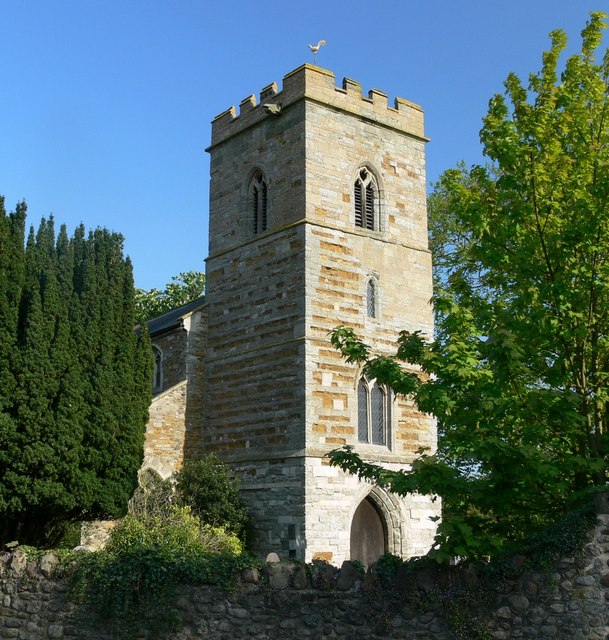
Church of St Helen, Saddington — west tower (1707 rebuild) with ironstone-and-limestone banding. Photo by Mat Fascione via Geograph / Wikimedia Commons · CC-BY-SA-2.0
The parish church of St Helen is a Grade II* listed building (Historic England List Entry 1188153, listed 18 March 1987).19 It stands at the southern end of the village, anchoring the Conservation Area together with Saddington Hall.20
The fabric tells a story of six centuries of construction:
13th century — oldest surviving elements: the south arcade of three bays with quatrefoil piers and pointed arches; the north doorway; the base of the west tower.
15th century — tower additions; clerestory inserted over the nave arcades.
1707 — tower substantially rebuilt after the medieval spire was removed. Four-staged with banded ironstone and limestone, embattled parapet, gargoyles.
1727 — north porch rebuilt.
1864 — Perpendicular-style east window inserted by Goddards of Leicester.
1872–73 — major restoration by architect Frederick Peck: new windows with reticulated tracery, organ chamber, removal of south porch and gallery, new north porch.
Furnishings include an octagonal 14th-century font with broach-stopped base; a 14th-century piscina; a remarkable 1570 Elizabethan silver Communion cup; and six bells, five cast 1760–77 by Thomas Eayre of Kettering. The oldest monument is an incised floor slab in the chancel commemorating Richard Holland, rector (d. 1628). Parish registers begin in 1538; Bishop's Transcripts from 1564.
The advowson — the right to appoint the rector — was given to Easby Abbey (Premonstratensian house, Yorkshire) by Richard de Rollos II and confirmed by Pope Celestine III before 1191. After the Dissolution of the Monasteries (1530s) it passed to the Crown. In 1927 the living was united with that of neighbouring Fleckney.
🌊Saddington Reservoir & Tunnel
Saddington Reservoir. 19.1 ha SSSI canal feeder reservoir, completed 1797. Photo by Chris Lowe via Geograph / Wikimedia Commons · CC-BY-SA-2.0
Saddington Reservoir was constructed between 1793 and 1797 as a feeder reservoir for the Leicestershire and Northamptonshire Union Canal — the line that eventually became the Leicester section of the Grand Union Canal. It is one of the older reservoirs in Leicestershire (sometimes described as the second oldest in the county).
Built
1793–1797
Purpose
Feeder for Grand Union Canal (Leicester Line)
Surface area
19.1 hectares (47 acres)
Grid reference
SP 663 910
SSSI status
Designated 1999 (biological)
The reservoir is a designated Site of Special Scientific Interest, its primary qualifying interest being four nationally scarce beetles: Carabus monilis, Atheta basicornis, Eledona agricola, and Gyrophaena lucidula. It is also a notable site for dragonflies (Emerald Damselfly, White-legged Damselfly, Ruddy Darter) and for county-rare birds — the first Leicestershire record of Great White Egret was here in 1988, and a Pallid Harrier in 1993 was a county first. Smew, Cetti's Warbler, Whooper Swan, Goosander, and Common Kingfisher are regular winter visitors.22
The associated Saddington Tunnel — also known as the Fleckney Tunnel — was completed in 1797. At 880 yards (~807 m), it is slightly crooked due to mid-construction surveying errors, lacks an internal towpath (boatmen "legged" their narrowboats through; horses were led over the top), and its construction so exhausted the canal company's capital that further canal extension was halted for years. Today it remains in use, with wide-beam passages booked 48 hours in advance. Bats roost inside.
Saddington Tunnel, south portal. Grand Union Canal, opened 1797. 880 yards (~807 m). Photo by Ashley Dace via Geograph / Wikimedia Commons · CC-BY-SA-2.0
In August 1865, after torrential rain, the canal embankment breached at Smeeton where the Saddington feeder joins the main channel: hundreds of yards of bank were washed away and ten miles of canal drained — one of the most dramatic infrastructure failures in Leicestershire canal history.
Recreational use today centres on the Saddington Sailing Club (Gumley Road, LE8 0QS), a 1.2-mile circular walking trail around the perimeter, and bird-watching from the Hensborough Hill trig point.
🌳Surname Formation
Locative surnames of the type de [place-name] arose in England from the 12th century onward, as individuals who left their home settlement became identified by it: John of Saddington → John de Saddington → John Saddington. Hereditary fixing — transmission of the name to offspring regardless of birthplace — occurred mainly in the 13th to 15th centuries.
The earliest known person to bear the surname was Nicholas de Sadingden, recorded in Berkshire in the 1273 Hundred Rolls (Rotuli Hundredorum).10 His record in Berkshire — well outside Leicestershire — is significant: it shows that geographic dispersal of the surname was already underway by the late 13th century. Thomas de Sadynton appears in the 1379 Yorkshire Poll Tax,11 confirming northward spread.
Single-Origin Implications
Because Saddington is a locative surname tied to a single small village, all bearers worldwide are presumed to share a relatively close common geographic origin. Unlike occupational surnames (Smith, Cooper, Baker) which arose independently in many places, locative surnames have a tightly bounded source region. The 1881 census distribution — with the highest per capita concentrations in Rutland, Huntingdonshire, Northamptonshire, and Leicestershire — confirms that the surname remained "locally endemic" near the village of origin even into the late 19th century.
The Saddington Y-DNA project (see below) is attempting to determine whether all modern Saddingtons descend from a single common male-line ancestor.
🌍Global Distribution Today
Forebears.io, drawing on genealogical, electoral, and census data, estimates the global Saddington population at approximately 1,936 individuals (2014 figures).12 The surname is globally rare, ranking 212,696th worldwide.
🏴England
1,248
🇦🇺Australia
368
🇺🇸United States
123
🇨🇦Canada
60
🇿🇦South Africa
39
🏴Wales
33
🏴Scotland
30
England accounts for roughly 64% of all global Saddingtons. Australia is disproportionately well-represented — 19% of the worldwide total despite a much smaller population than the United States — reflecting a substantial 19th-century emigration wave (see Migration & Diaspora).
Within England, the modern county distribution remains heavily weighted toward the East Midlands. The 2014 figures show roughly 11% of English Saddingtons in Leicestershire, 10% in South Yorkshire, and 9% in Greater London. The Office for National Statistics 2002 figure for England, Wales, and the Isle of Man was 1,326 living Saddingtons, ranking the surname 5,251st most common.13
📊Historic Census Distribution
The 1881 census of Great Britain recorded 619 individuals named Saddington (604) or Sadington (15).16 By absolute numbers, the largest concentrations were in Northamptonshire, Leicestershire, and Middlesex. By concentration per 100,000 residents, however, the picture shifts — revealing the locative surname's persistent gravity around the village of origin:
County (1881)
Bearers
Per 100,000
Northamptonshire
131
48
Leicestershire
93
29
Middlesex (incl. London)
81
—
Huntingdonshire
74
59
Rutland
—
135
Lincolnshire
25
—
Hertfordshire
12
—
London
11
—
Rutland's extraordinary concentration of 135 per 100,000 — the highest of any English county — reflects its geographic proximity to Saddington village. Huntingdonshire's prominence indicates an early migration corridor north-east from Leicestershire.
The 1921 census, indexed by Findmypast, returns 6,760 Saddington records. The most common male occupations were agricultural labourer (77), blacksmith (26), and butcher (26); the most common female occupations were dressmaker (24), general servant (20), and laundress (19).17 This is a recognisably late-Victorian rural-industrial occupational profile.
⛵Migration & Diaspora
The earliest documented Saddington in the New World is Jonas Saddington, recorded in Virginia in 1637 — making the family one of the very earliest English settlers in the American colonies, predating the Mayflower's 1620 voyage by only seventeen years.
To the United States
Documented 19th-century US migrations include Eaton Saddington (c.1831–1892), who arrived at Liverpool aboard the Ashburton in September 1851, settling in Davison, Genesee County, Michigan, with siblings Eliza and Elizabeth. His brother Thomas died in 1866 while serving in the 30th Michigan Volunteer Infantry during the Civil War. Other early settlers reached Philadelphia, New York, Iowa, Oregon, and Delaware. The US Saddington population grew +384% between 1880 and 2014 — a high rate from a small base.
To Australia
Australia received the proportionally largest Saddington diaspora. The only confirmed convict transport was Eliza Saddington, who departed England aboard the Emma Eugenia on 25 October 1850 and arrived at Van Diemen's Land (Tasmania) on 7 March 1851. The voyage carried 170 female convicts; six died en route.
The largest documented free-settler family was Samuel Saddington (1807–1875), a butcher who departed London aboard the Barrackpore on 7 December 1853 with his wife Emma and six children, settling in Macedon, Victoria. He died on Christmas Eve 1875 and was buried in Melbourne General Cemetery. Multiple branches subsequently spread to Tasmania, Western Australia, and New South Wales.
To Canada
William Edward Saddington arrived in Banff, Alberta, in 1888. He fought in the Boer War with Lord Strathcona's Horse, married Emily Mary Burton in 1903, and founded a Canadian line; he died in 1950. Arthur N. Saddington (1872–1958) emigrated separately and served as Banff's first postmaster from c.1900 to 1936; the 1909 Saddington Home on Otter Street remains an object of heritage preservation. Kate Saddington and her sister Emma Jane settled in Muskoka, Ontario, around 1900–1910.
To New Zealand & South Africa
New Zealand received Saddington settlers in the 19th century, though specific ship records remain to be located in NZ state archives. South Africa's modern population of 39 (Forebears 2014) likely arrived chiefly via the Boer War military connection (the 1820 Settlers index does not include the surname) or later 20th-century migration.
origin17th c.19th c. (US/Canada)convictfree settlerHover any pin for the family story.
🧬Y-DNA Project & One-Name Study
The Saddington One-Name Study was registered with the Guild of One-Name Studies in 2006 and is administered by Rowan Tanner ([email protected]).14 The study covers Saddington and its registered variants (Saddlington, Sadinton, Suddington) globally, holding 367 marriages (members), 220 probate records, and a structured datastore of 405+ items. The Guild estimates that approximately 4,641 individuals have ever borne the name across roughly 500 years of records.
The associated Saddington DNA Project is hosted at FamilyTreeDNA and currently has 15 enrolled participants.15 The project tests Y-DNA (males only, 37-marker minimum) and mitochondrial DNA. Its goal is to determine which Saddington family trees are genetically connected and to document surname evolution. Public haplogroup assignments have not yet been published.
For genealogical researchers, the most thoroughly documented line begins with Joseph Saddington (b. before 1677, d. c.1752) of Desford, Leicestershire. His son Bateman Saddington (1728–1804) became a prominent apothecary on Fleet Street, London, rising to Upper Warden of the Society of Apothecaries (1803). His brother John founded the Appleby Magna branch, which produced Samuel Saddington of Macedon, Victoria. Other major progenitor lines include John Saddington of Foxton (1737–1799) and Joseph Saddington (1763–1827) of Church Gresley.
No verified heraldic grant exists for the Saddington surname in the public records of the College of Arms. Commercial "family crest" vendors offer downloadable images, but these are not authoritative grants of arms.
This is the expected pattern for locative surnames originating in small villages: such names are overwhelmingly associated with yeoman and agricultural stock rather than armigerous gentry. The one medieval exception — Sir Robert de Sadington, Lord Chancellor — gained access to armorial connections through marriage to Joyce Mortival (sister of Roger de Mortival, Bishop of Salisbury), not through an original Saddington grant. No Saddington-specific arms appear in Burke's Peerage, Burke's General Armory, or Papworth's Ordinary of British Armorials.
🏅The Saddington Power Ranking
An entirely subjective leaderboard ranking the most consequential Saddingtons of all time — weighting historical office, cultural impact, peer-reviewed scholarship, and search dominance. Updated as new bearers earn entry. Disagree? Tell Peter.
1
Sir Robert de Sadington (d. c.1361)
Lord Chancellor of England 1343–45 · Chief Baron of the Exchequer · Lord High Treasurer. The highest office ever held by a Saddington in history.
🏛 ENG officeholder
2
Peter Saddington (b. 1982)
Best-known Bitcoin Lambo purchase (45 BTC, 2017) · trained 17,000+ professionals · $33M+ deployed across StaaS Fund · Wikidata Q138786050. The most Google-prominent Saddington alive today.
3B+ social views
3
Wendy Saddington (1949–2013)
Australian blues / soul singer · named the band Chain · co-led Copperwine · 1972 Top 30 hit "Looking Through a Window" · "by far the best female rhythm and blues singer in the country" (1969).
🎤 AUS music legend
4
John Saddington (c.1634–1679)
"Saddington the Tall." London sugar merchant; pre-eminent lay theologian of the early Muggletonian church; author of The Articles of True Faith (1675), still in print 350 years later.
📖 350 yrs in print
5
Denis Bain Saddington (1931–2011)
Rhodes Scholar · Professor of Roman History at Wits · the standard scholarly authority on Roman auxiliary forces. Obituary: praefectus de auxiliis historicorum.
🏛 RSA Rhodes Scholar
6
Jason Saddington (b. 1979)
142 AFL games for Sydney Swans · 20 for Carlton · AFL Rising Star nominee 1998 · head of GWS Giants Academy. Combined with uncle Col, the only AFL uncle-nephew duo with 100+ games each.
162 AFL games
7
Bateman Saddington (1728–1804)
Apothecary on Fleet Street · Upper Warden of the Society of Apothecaries 1803 · on track to become Master before his death.
⚗ Fleet St apothecary
8
Leicester Birkenhead Saddington OBE (1912–1962)
NSW Legislative Council 1952–62 · OBE 1960. The most extraordinary forename in Saddington history — preserving the mother's surname (Birkenhead) and the family seat (Leicester).
🇦🇺 OBE 1960
9
Col Saddington (1937–2012)
Richmond VFL ruckman 1956–1962 · equal-most Brownlow votes for Richmond in 1959 · coached the 1973 reserves premiership.
102 VFL games
10
George Saddington (1907–1986)
Hull KR / York rugby league forward · capped twice for Great Britain in 1934 (vs Australia & France).
🏉 GB international
Just outside the top 10: Hayley Saddington (WEF Young Global Leader, MedTech founder), David Saddington FRGS (UN COP21 lead engagement), Liam Saddington (Cambridge geographer, Pilkington Prize 2025), Alistair Saddington (Cranfield aerospace), Edmund Saddington (Chapels Royal, Tower of London), Sharron Saddington / Fortnam (Cardiacs / North Sea Radio Orchestra).
👑Notable Saddingtons in History
The following individuals have substantive historical or biographical sourcing — an entry in the Oxford Dictionary of National Biography, a Wikipedia article, or comparable peer-reviewed scholarship.
Sir Robert de Sadington (d. c.1361)
England · Lord Chancellor · Medieval jurist
The most historically significant Saddington on record. Born in or near Saddington, Leicestershire, possibly the son of John de Sadington, valet to Isabella of France (wife of Edward II). He rose through the English legal system from advocate to Chief Baron of the Exchequer (1337–1343, then again 1345–1349) — the first Chief Baron summoned to parliament by that title. He served as Lord High Treasurer (May–June 1340) and Lord Chancellor of England under Edward III from 29 September 1343 to 26 October 1345 — only the third layman to hold the chancellorship during that reign. He was guardian of Wales, Cornwall, and Chester during the Black Prince's minority (1346) and presided over the commission that tried the earls of Fife and Menteith after the Battle of Neville's Cross (1347). He married Joyce, sister of Roger de Mortival, Bishop of Salisbury; their daughter Isabel married Sir Ralph Hastings.
Edward III's Great Seal, 1340s. The fifth-version seal in active use during Sir Robert de Sadington's tenure as Lord Chancellor of England, 1343–1345. No contemporary portrait of Sir Robert survives. Image: The National Archives UK / Wikimedia Commons · Public Domain
John Saddington (c.1634–1679)
England · Muggletonian theologian · Sugar merchant
Born in Arnesby, Leicestershire; a London sugar merchant popularly known as "Saddington the Tall" for his striking physical stature and good looks. He became one of the most prominent early adherents to Muggletonianism — the heterodox Protestant movement founded in 1651 by Lodowick Muggleton and John Reeve, whose followers held that the two London tailors were the final prophets of Revelation. Saddington styled himself "the eldest son of the Commission of the Spirit" and authored six works defending Muggletonian theology, two of which were published: A Prospective-glass for Saints and Sinners (1673) and The Articles of True Faith (1675), reprinted in 1830, 1880, and 2010.
Born 1 September 1728 in Desford, Leicestershire, son of Joseph Saddington. Rose to become a prominent apothecary on Fleet Street, London, serving as Upper Warden of the Society of Apothecaries in 1803 and on track to become Master before his death in February 1804. His will was proved 16 February 1804 (National Archives). His brother John founded the Appleby Magna branch of the family that produced 19th-century emigrants to Victoria, Australia.
Born 27 July 1912 in Mayfield, New South Wales, to Percy Saddington (insurance broker) and Clara Birkenhead. The unusual forename and middle name reflect the Victorian practice of embedding the mother's surname. Educated at Cooks Hill, NSW. Married Claire Hogarth in 1937; three children. During WWII he served in the Newcastle National Emergency Services. A director of the family insurance firm, he was elected as a Liberal member of the NSW Legislative Council in 1952, serving until his death in 1962. Appointed Officer of the Order of the British Empire (OBE) in 1960. Died of a heart attack in Newcastle; ashes interred at Christ Church Cathedral, Newcastle.
Born 26 September 1949 in Melbourne to Henry Saddington (bus driver) and Connie Evans. A foundational voice in Australian blues and soul music. She gave the band Chain its name (after Aretha Franklin's "Chain of Fools"), co-led Copperwine with Jeff St John (1970–71), and reached the Top 30 with her 1972 solo single "Looking Through a Window," produced by Billy Thorpe. She also wrote the popular advice column "Takes Care of Business" for the teen pop newspaper Go-Set (1969–70). In 1972 she joined ISKCON (the Hare Krishna movement), taking the spiritual name Gandharvika Dasi. Returned to music in 1983 with the Wendy Saddington Band. Died 21 June 2013, aged 63, of oesophageal cancer.
South Africa / Zimbabwe · Classical scholar · Roman military historian
A Rhodes Scholar at Corpus Christi College, Oxford, who returned to academic posts at the University of Natal, the University of the Witwatersrand (joined 1958, ad hominem Professor of Roman History 1983–1993), and the University College of Rhodesia (full Professor of Classics 1978). His foremost scholarly work is The Development of the Roman Auxiliary Forces from Caesar to Vespasian, 49 BC–AD 79 (University of Zimbabwe, 1982), the standard reference on Roman auxiliaries. He contributed to A Companion to the Roman Army and was selected to the Committee of Honour at the 2009 Limes Congress (Newcastle) — a signal honour in Roman frontier studies. His obituary in Acta Classica styled him praefectus de auxiliis historicorum: "commander of the historians of the auxiliaries."
Ruckman and defender for Richmond in the Victorian Football League, 1956–1962 (102 games, 10 goals). Polled equal-most Brownlow Medal votes by a Richmond player in 1959. Played in Richmond's victorious 1962 night grand final and once took 16 marks in a single match against Essendon. After his VFL career he played 26 games for Sturt (SANFL); won the 1967 Western Border premiership as playing-coach of Coleraine; and coached Richmond's reserves to the 1973 premiership, earning life membership.
Born in Barking, Essex; died in Hull. A second-row forward who played 171 appearances (34 tries) for Hull Kingston Rovers and also for York in the 1930s. Represented Great Britain twice in 1934 (against Australia and France) and represented Rugby League XIII vs France — earning full international honours.
Born in Sunderland on 9 December 1965. A defender who played for Doncaster Rovers, Sunderland, and Carlisle United (over 100 appearances; club captain under Clive Middlemass), as well as Gateshead. His professional career was cut short at age 25 by a diagnosis of myalgic encephalomyelitis (ME). He worked as a car salesman in the North East after retirement. Died 24 January 2019, aged 53, of heart disease; both Sunderland AFC and Carlisle United paid tributes.
Born 23 October 1979 in Mitcham, Victoria. Drafted #11 in the 1997 AFL national draft from Eastern Ranges. Played 142 games for Sydney Swans (1998–2005), 20 games for Carlton (2006–2008) — 162 AFL games, 47 goals total. Nominated for the AFL Rising Star award (1998) and won the Northern Bullants' Laurie Hill Trophy in 2008. Since 2014 he has been Academy Coach of the GWS Giants; named Coach of the NAB AFL U18 All Australian Team 2014. Nephew of Col Saddington — the only uncle-nephew pair in AFL history both achieving 100+ games under the same surname.
The first mayor of Port Credit, Ontario, when it achieved town status in 1961. (Port Credit had been a village since 1909 and merged into the City of Mississauga in 1974.) A 1966 Peel County newspaper feature profiled him as "personality of the week." The 17.5-acre J. C. Saddington Park, where the Credit River meets Lake Ontario, is named in his honour and remains one of Mississauga's principal waterfront parks.
Born in London, England, in 1872; died in Victoria, British Columbia, in 1958. Emigrated to Canada and arrived in Banff around 1900. Served as Banff's first postmaster from c.1900 until his retirement in 1936 — a tenure of more than three decades. Married Annie Ward in 1906. The 1909 Saddington Home on Otter Street in Banff has been the subject of heritage preservation efforts.
The contemporary Saddingtons most visible in public life. By Google search dominance and aggregate media footprint, the most prominent living Saddington is currently Peter Saddington (United States), but the name is well-represented across academia, defence, finance, environmentalism, racing, and the arts.
Peter Saddington (b. 1982)
United States · AI trainer · VC · Bitcoin OG · Wikidata Q138786050
Born in Busan, South Korea; Korean-American. The most publicly prominent living Saddington. Bought his first Bitcoin at $2.52 in 2011; in October 2017 bought a Lamborghini Huracan for 45 BTC, becoming widely credited as the first publicly identified Bitcoin Lamborghini buyer, originating the "wen lambo" crypto meme — a story covered by CNBC, Forbes, Bloomberg, Popular Mechanics, Yahoo Finance, Maxim and 40+ outlets across 12 countries. Author of The Agile Pocket Guide (Wiley, 2012) and Gravity (2020). General Partner of StaaS Fund ($33M+ deployed across three funds since 2014); Certified Scrum Trainer (2012); has trained 17,000+ professionals. Co-founded VINwiki (2016) with Ed Bolian. Founder of the Collegiate Racing Series (CRS), a college motorsports league across 61+ US universities (founder and largest shareholder; not in an operational role since 2026), and of Bitcoin Race Team USA. Wikidata: Q138786050.
United States · Youngest licensed pro racing driver in the US
At age 12 in August 2025, Joseph obtained a Professional Competition Racing License with FARAUSA at Homestead-Miami Speedway, becoming one of the youngest licensed professional racing drivers in the United States. He has 30+ podium finishes in karting and raced 9 Pro Spec Miata events with FARAUSA in 2025 in the #81 TOSHI car for Bitcoin Racing USA. With over 1.4 billion combined social media views (TikTok @saddingtonracing, 125,000+ followers), he is among the most-watched young drivers in motorsport. Son of Peter Saddington.
A British environmentalist from North Yorkshire who, as a teenager, lobbied Prime Minister Tony Blair to introduce climate change into the UK national school curriculum. Studied geography at Durham University; MSc in Hazard, Risk and Security. The United Nations invited him to lead public engagement at COP21 in Paris, where he moderated the Intergenerational Inquiry panel with Christiana Figueres (UNFCCC Executive Secretary) and Ségolène Royal. Three TEDx talks including "Why I Don't Care About Climate Change" at London's O2; appointed Head of International Climate Strategy in 2024; Fellow of the Royal Geographical Society. Won the 2017 WWF Earth Hour Hero Award.
England · University of Cambridge · Human geography
Teaching Associate in Human Geography at the University of Cambridge; Fellow and Director of Studies in Geography at Lucy Cavendish College, also affiliated with Magdalene College. BA, MSc, and DPhil all from Oxford (St Catherine's College). DPhil thesis: Rising Seas and Sinking Islands: The Geopolitics of Climate Change in Tuvalu and Kiribati. Won the Pilkington Prize for Teaching Excellence in 2025. 111+ Google Scholar citations. Currently leads collaborative climate adaptation research in Cabo Verde funded by the Mastercard Foundation.
England · Cranfield University · Defence aeronautics
Professor of Defence Aeronautics and Head of the Centre for Defence Engineering and Physical Science at Cranfield University's Shrivenham campus — the UK's main military academic institution. BEng (Hons) Aeromechanical Systems Engineering and EngD, both Cranfield. Former Rolls-Royce Bristol engineer specialising in compressor aerodynamics for the Lockheed F-35. 25+ years in aerospace; 50+ peer-reviewed publications; Chartered Engineer; Fellow of the Royal Aeronautical Society. Specialist in STOVL aircraft propulsion integration, CFD, and autonomous-systems airworthiness. Defence clients include BAE Systems, Leonardo, and the Ministry of Defence.
Australia · MedTech founder · WEF Young Global Leader
Founder and CEO of Peak Medical, an AI-powered digital rehabilitation technology company. Founded HALO Medical Devices (2012–2021), which developed a goniometer used in 23 countries and won the People's Choice Award on ABC-TV's New Inventors; appeared on SharkTank Australia. Studied physiotherapy at Harvard University; Entrepreneur in Residence at UNSW Business School; 2025 Innovator of the Year at the Women In Digital Awards. World Economic Forum Young Global Leader.
Partner in the Tax Group at Goodmans LLP, Toronto. Advises on Canadian domestic and international income taxation in corporate transactions. Frequent lecturer at Osgoode Hall Law School. Named "Lawyer to Watch" in Lexpert Special Edition: Insolvency and Restructuring 2024; recognised in Best Lawyers in Canada 2024. JD from the University of Western Ontario.
Australia / Hong Kong · Global marketing director, EY
Global Director, Brand Marketing & Communications, EY Financial Services (Ernst & Young), leading a global team across Banking & Capital Markets, Insurance, and Wealth & Asset Management. Previously Director, Brand Marketing & Communications, Asia Pacific at EY. BA Communications from the University of Technology, Sydney.
First-Class Honours, Architectural History (University of Edinburgh); Distinction, Bartlett School of Architecture, UCL. Architect and Project Adviser at Freehaus; previously Associate Director at Morris+Company. Writer on architecture for the Financial Times, The Developer, and other publications. Won Feature Writer of the Year, International Building Press Awards 2025; won the inaugural Luxembourg Prize for Architectural Criticism. Member of the Kingston Placemaking Panel, Medway Design Review Panel, and Design South East Expert Panel.
Born in Kingston upon Hull. Vocalist, bass guitarist, and songwriter on the British experimental music fringe for over 30 years. Member of The Shrubbies (1996–1999, lyric writer), recorded with Cardiacs, and lead vocalist of the North Sea Radio Orchestra (5 albums). Has also performed with Lake of Puppies, Arch Garrison, Lost Crowns, and Led Bib. Records under both Saddington (older releases) and Fortnam (since marriage to composer Craig Fortnam). Launched her solo project Kugelschreiber in 2024.
An English bass-baritone who trained at The Minster School, Southwell (chorister at Southwell Minster) and Trinity College of Music, London (with Brindley Sherratt). Lay clerk at Winchester Cathedral 2010–2015. Permanent member of the Chapels Royal at HM Tower of London. Regular soloist with the Marian Consort, the Monteverdi Choir under Sir John Eliot Gardiner (Bach Cantata Pilgrimage), the Gabrieli Consort under Paul McCreesh, BBC Singers, Cambridge Singers under John Rutter, Collegium Vocale Gent under Philippe Herreweghe, and ORA Singers. Singing teacher at Eton College.
Born in Washington, DC. BA from Concordia University, Montreal; MFA from Columbia University, New York (2008). Represented by James Fuentes gallery (Lower East Side, NYC) and Ceysson & Bénétière. Works in oil on canvas using an improvisational, emotionally charged method. Exhibitions include Know More Games (NYC), MoMA PS1 Art Book Fair, Night Gallery (Los Angeles), and Franco Soffiantino Arte Contemporanea (Turin).
The Saddington One-Name Study, in cross-reference with the Commonwealth War Graves Commission, has documented at least 21 Saddingtons killed in the First World War and several in the Second. Two earned the Military Medal. They are remembered here in perpetuity.
🌹
First World War — 1914 to 1918
John William Saddington
Gnr 74541, 114th Bty 25th Bde RFA
Killed 20 Sep 1914 · France
Nathan Saddington
Pte 7583, 5th Dragoon Guards
Killed 31 Oct 1914 · First Ypres, Belgium
Joe Saddington
Pte 1319, 1/5th Bn Leicesters · Boer War veteran
Killed 31 May 1915 · Bailleul, France · age 40
Claridge Saddington
Pte 18845, 3rd Bn Northants Regt
Died 14 Mar 1916 · England · age 24
George Frederick Saddington
Cpl 283, 21st Bn Australian Infantry
KIA 24 Apr 1916 · France · age 22
Joseph Robert Saddington
Pte 8971, 1st Bn Bedfords
KIA 27 Jul 1916 · the Somme, France
George Henry Saddington
Pte 24954, 1st Bn Leicesters
KIA 15 Sep 1916 · the Somme · Thiepval Pier 3A
Charles William Saddington
Pte 202906, 1/4th Bn Leicesters
KIA 22 Apr 1917 · France · age 29
Charles William Saddington
Pte 30618, 7th Bn Bedfords
KIA 3 May 1917 · France
William Henry Saddington
Pte 306959, 2/7th Bn Duke of Wellington's
KIA 3 May 1917 · France · age 20
William James Saddington
Pte 265241, 2/6th Bn Duke of Wellington's
DOW 12 May 1917 · Bullecourt · age 25
Ben Saddington
Pte 50630, 10th Bn Cheshire Regt
DOW 14 Jun 1917 · France · age 23
John Thomas Saddington
L/Cpl 11255, 6th Bn DCLI
KIA 9 Apr 1917 · France
Thomas Saddington
Pte 16/1498, 24th Bn Northumberland Fus
KIA 9 Apr 1917 · France
George Herbert Saddington
Sjt 240289, 2/5th Bn Leicesters
DOW 28 Sep 1917 · Belgium
George Henry Saddington MM
Sjt G/1435, 7th Bn Queen's Own R W Kents
KIA 12 Oct 1917 · Passchendaele · age 24
Frederick Saddington
Sapper 256465, 260th Railway Construction Co. RE
KIA 10 Dec 1917 · Belgium · age 26
James Saddington MM
Cpl 587, 40th Bn Australian Infantry
KIA 21 Feb 1918 · Warneton, Belgium · age 24
Harold James Saddington
Pte 495595, 13th Bn London Regt (Kensington)
KIA 28 Aug 1918 · France · age 19 · Buissy-Queant
Frederick William Saddington
Pte G/62045, 20th Bn Middlesex
KIA 28 Sep 1918 · Belgium · age 18
David Thomas Saddington
L/Cpl G/14206, 19th Bn Middlesex
KIA 3 Oct 1918 · Belgium · age 39
Second World War
Harold William Saddington
Pte 2825673, 2nd Bn Seaforth Highlanders
Died 3 Jan 1941 · Hull · ~25 · Hedon Road Cemetery
Samuel Saddington DSM
Chief Engine Room Artificer, Royal Navy (NZ)
WWII · commemorated by NZ War Graves Project
"They shall grow not old, as we that are left grow old." — Laurence Binyon, For the Fallen (1914). At least 21 Saddingtons were killed in the Great War from a 1911 UK population of barely a thousand. Two earned the Military Medal in Belgium, four months apart. We remember them.
🏆Saddingtons in Sport
Col Saddington — Australian rules football, Richmond/Sturt 1956–1965 (see above).
Jason Saddington — AFL, Sydney Swans / Carlton 1998–2008; GWS Giants Academy coach (see above).
Joseph Saddington — one of the youngest licensed pro racing drivers in the US (see above).
Peter Saddington — SCCA-licensed competitor and MSF2 instructor; founded the Collegiate Racing Series across 61+ universities (see above).
George Saddington — rugby league, Hull KR / York / Great Britain 1934 (see above).
James Saddington (Kyle James Charles, b. 10 May 1991, Leicester) — cricketer; left-hand bat / right-arm fast-medium; played for Great Britain Combined Universities. ESPNcricinfo.
🎨Saddingtons in Arts & Academia
Wendy Saddington — Australian blues/soul singer (see above).
Sharron Saddington / Fortnam — English experimental musician (see above).
Edmund Saddington — bass-baritone, Chapels Royal (see above).
Amelia Saddington — visual artist, James Fuentes gallery (see above).
Liz Saddington — Cornish watercolour artist; created cover artwork for the progressive rock band Pendragon. lizsaddington.com
Lesley Saddington — UK figurative/symbolic painter; received a London Transport commission for a theatre/film heritage poster. Artfinder
Sophie Saddington — Dutch-Scottish autodidact filmmaker; The Patter of the Poets (2024). BA/MA in Philosophy, History, and Literature; Amsterdam-based. sophiesaddington.com
Frances Saddington — British screen actress: Trying (Apple TV+), The Flatshare, Chloe (BBC). IMDb
Marianne Saddington — South African / British paper-maker, calligrapher, and author of Making Your Own Paper (Storey Publishing, 1991), reprinted in five countries.
Denis Bain Saddington — Roman military historian (see above).
Liam Saddington — Cambridge geographer (see above).
Alistair Saddington — Cranfield aerospace engineer (see above).
Dr David Saddington PsychD — clinical psychologist, Shrewsbury; Taproot Psychology; specialist in trauma therapy.
Dr Joanna Saddington — consultant clinical psychologist, Stafford; Saddington-Spring Counselling.
Dr Toni Saddington — dentist, Terrey Hills, Sydney (UK-qualified 1982).
John Saddington (American) — serial tech entrepreneur and prolific blogger; built and sold Datecraft (40,000-user WoW dating network), Gospelr (acquired 2009), the Standard Theme WordPress framework; co-founded The Iron Yard, a 15-campus coding bootcamp acquired by a Fortune 500. Adopted Korean twin raised in New Jersey.
💼Saddingtons in Business
Chas Saddington — co-founder of Saddington Baynes, London (1991), with Dick Baynes; advertising and creative retouching pioneer since the 1960s.
Rod Saddington — hedge fund portfolio manager; founder/CIO of Merewether Investment Management LP, Dallas; previously Carlson Capital, Och-Ziff, Morgan Stanley.
Amy Saddington — Managing Director, North American Healthcare Services Practice at Russell Reynolds Associates, Dallas.
Hayley Saddington — founder/CEO of Peak Medical (see above).
John Saddington (Diadem DDM, Sydney) — co-founder of an architectural signage and wayfinding consultancy.
Jon Saddington — founder of Saddington Taylor Planning Consultancy, Darlington (2016); director of Darlington Football Club.
Scott Saddington — EVP Broking Solutions at PLATFORM (Toronto); 30+ years senior insurance experience across Toronto, New York, LA, Sydney, London.
Andy Saddington — Principal Consultant, Business Strategy at C3IA Solutions (NCSC-certified UK cybersecurity consultancy); former Royal Signaller.
Matt Saddington — Senior Global Equities Analyst & Portfolio Manager, Bell Asset Management, Melbourne (28 years).
Carolyn Saddington — Managing Director, loyaltyMATTERS Ltd, Harrogate; former Board-level Director at Georgia-Pacific and Premier Foods.
Peter Saddington (Tekever) — UK lead for Tekever's Sensor Systems team since 2014; pan-European AI-centric defence autonomous systems.
Todd Saddington — Director of Finance, The PBE Group (Newcastle, NSW).
Brian Saddington — Senior Engineer (Design), J Murphy & Sons (UK civil engineering).
R. V. (Robert Vernon) Saddington (1860–1933) — prominent Sydney resident of Wahroonga; Sydney Morning Herald obituary.
🏢Companies & Brands
Saddington Baynes — London creative production studio founded 1991 by Chas Saddington and Dick Baynes. Pioneer of CGI in advertising; first studio to use neuroscience (biometric nonconscious measurement) in production via "Engagement Insights®" (2014). Cannes Lions and CLIO winner; major work for Honda and Ferrari. Went into administration 2022; portfolio acquired by Glen Taylor under the ALONGSIDE collective; relaunched March 2024 as a healthcare-focused creative production studio. saddingtonbaynes.com
Saddington Taylor Ltd — planning and development consultancy, Darlington, founded January 2016 by Jon Saddington.
Saddington Racing — Joseph Saddington's racing brand; saddingtonracing.com.
Saddington's Building Supplies — building materials retailer in Boolaroo, NSW, Australia.
Merewether Investment Management LP — Dallas hedge fund founded 2018 by Rod Saddington.
Peak Medical — Australian AI rehabilitation startup founded 2021 by Hayley Saddington.
Saddington Limited — new Leeds-based company incorporated 23 December 2024 in the public houses and bars sector.
📍Places & Things Named Saddington
An expanded inventory of every named landmark, building, street, business, recording, or institution that bears the Saddington name worldwide. Approximately 85+ entries across 11 categories, drawn from Historic England, OpenStreetMap, Companies House, ASIC/ABN Lookup, the Saddington Family History Blog, and other public sources.
The Village & its Listed Buildings
Saddington village in South Leicestershire has been a designated Conservation Area since 1975 (Harborough District Council). Within the conservation area:
Church of St Helen — Grade II* listed (Historic England NHLE 1188153). 13th-century origins; 1872–73 restoration by Frederick Peck. (See St Helen's Church.)
Saddington Hall — Grade II listed (NHLE 1188146). Three building phases 1674–1806; private residence.
Saddington Lodge (formerly Glebe Farm) — Grade II listed; c.1850; housed the Rector during the 1870s Rectory rebuild.
The Manor House, Saddington — Early-19th-century stuccoed L-shaped house with Greek Doric doorway; west of the church.
The Old Rectory — Grade II listed; c.1870–80, built when the Rectory was reconstructed.
Limes Farmhouse and Garden Wall — Grade II listed (NHLE 1061486); c.1800.
Sunnydale Farmhouse — Grade II listed (NHLE 1188155); mid-18th century. One of the oldest surviving domestic buildings in the village.
Yew Tree House — Grade II listed; former Victorian chapel converted to residence.
Ivydene, Cedar House, Harlain Cottage (17th-century timber-framed) — all Grade II listed within the Conservation Area.
The Grange — Stuccoed c.1850 house at the north end of the village; now operated as The Grange Nursing & Residential Home (50 beds, CQC-registered).
The Dovecot — Early-18th-century brick dovecot with ~600 nesting holes, between the Manor House and its farm buildings. Manorial-rights structure: only manorial lords held the right to keep a dovecot.
General Baptist Chapel — Grade II listed; 1848 red-brick chapel with elliptical window heads.
Saddington National School — 1855 red-brick and blue-brick building; reduced to junior school 1931. Building still stands.
The Queen's Head pub — whitewashed Main Street pub on Everards tenancy; The Queen's Head Farm Shop opened 2013 (Pub is The Hub).
Lodge Farm — working farm on Shearsby Road, LE8 0QU.
Saddington Riding School (Manor Farm Riding School & Livery) — equestrian school established 35+ years ago at Manor Farm, Main Street.
Saddington Reservoir & Tunnel
Saddington Reservoir — 19.1 ha SSSI feeder reservoir, built 1793–97; eBird hotspot L5756374, 108 species recorded. (See above.)
Saddington Tunnel (also Fleckney Tunnel) — Grand Union Canal Leicester Section, 880 yards, opened 1797. Slightly crooked, no towpath.
Saddington Avenue — Hoppers Crossing, Victoria 3029, Australia (City of Wyndham, ~24 km SW of Melbourne).
Saddington Street — Gravesend, Kent (DA12 1EB), inner-town near Gravesend railway station; St Marys, NSW; South Turramurra, NSW.
Saddington (no suffix) — Woughton Park, Milton Keynes (MK6 3EH). Part of the Campbell Park / Old Woughton 1970s estate, where Milton Keynes Development Corporation used Leicestershire village names as a thematic naming system.
Parks & Public Spaces
J. C. Saddington Park — 17.5-acre waterfront park, Port Credit, Mississauga, Ontario; named for J.C. "Cy" Saddington, Port Credit's first mayor (1961). Where the Credit River meets Lake Ontario.
Brueckner Rhododendron Gardens — named sub-garden within J.C. Saddington Park.
Saddington Conservation Area — designated 1975 (Harborough District Council); covers most of the historic core of Saddington village.
The 1909 Saddington Home — heritage building on Otter Street, Banff, Alberta; former home of Arthur N. Saddington, Banff's first postmaster (c.1900–1936).
Education
KU South Turramurra Preschool (formerly Ku Saddington Street Community Preschool) — 1 Saddington Street, South Turramurra, NSW. KU Children's Services-operated since c.1962.
Healthcare
The Grange Nursing & Residential Home, Saddington — 50-bed CQC-registered care home (Smeeton Road, LE8 0QT).
P.W. Saddington & Sons Pty Ltd — Australian building supplies company, est. 1921 in Newcastle, NSW. Now four locations across Hunter Valley as Saddingtons Building Supplies. Three generations of family management.
Saddington Baynes — London creative production studio; founded 1991 by Chas Saddington and Dick Baynes. Cannes Lions and CLIO winner; pioneer of CGI in advertising. Went into administration 2022; relaunched March 2024 as a healthcare-focused studio.
The Saddington Baynes Group Limited (CH 07716903), Saddington Baynes Digital Ltd (CH 07685942), Saddington & Baynes LLP (CH OC307521) — the historical corporate structure.
Saddington Taylor Ltd — planning and development consultancy, Darlington, founded January 2016 by Jon Saddington.
Saddington Racing — Joseph Saddington's racing brand; saddingtonracing.com.
Saddington Investments Limited (CH OE027108) — overseas company, incorporated British Virgin Islands; registered in the UK 20 February 2023.
Saddington Construction Pty Ltd, Saddington Builders Pty Ltd, Saddington Stainless, Saddington Haulage (Norseman/Kalgoorlie, WA) — further Australian Saddington-named businesses (active and historical) recorded in ASIC/ABN.
Saddington Insurances Pty Ltd, Saddington J.T.M. Pty Ltd, Saddington Super Fund, Saddington Family Trust — NSW/Victoria registered entities.
JK Saddington Company, Inc. — Jordan K. Saddington's California construction company.
Wendy Saddington & The Copperwine Live — live album, Australia, 1971 (Infinity Records). The primary recorded document of Wendy Saddington's career.
"Looking Through a Window" / "We Need a Song" — 7" single, September 1971 (Festival/Infinity INK 4308). Wendy Saddington's debut solo single, co-produced by Billy Thorpe; reached no. 22 on Australian charts.
Cardiacs — Guns (1999) — album featuring Sharron Saddington as guest vocalist on "Spell with a Shell," "Clean That Evil Mud Out Your Soul," and "Will Bleed Amen."
Amelia Saddington — Open Topic — 7-track experimental pop album by visual artist Amelia Saddington (as "Open Topic"), Brooklyn, 26 October 2022.
Women 'n Blues — 2003 Australian compilation featuring three Wendy Saddington tracks alongside Kate Dunbar, Jeannie Lewis, Margret RoadKnight.
Heritage & Reference Entries
Saddington (Domesday Book entry, 1086) — the place-name's first written attestation, as Sadintone.
Survey of English Place-Names entry — English Place-Name Society, University of Nottingham. Records historical spellings from 1086 to the modern form.
Saddington One-Name Study — Guild of One-Name Studies, registered 2006; managed by Rowan Tanner.
Saddington DNA Project — FamilyTreeDNA, 15 enrolled participants; tests Y-DNA and mtDNA.
Folklore
The Saddington Treacle Mine — fictional folkloric attraction at Saddington village; part of the long-running English "treacle mining" hoax tradition. There has never been a treacle mine in Saddington.
🪄Folklore & Curiosities
The Saddington Treacle Mine
One of the village's persistent local jokes is the existence of a fictional "Saddington Treacle Mine." "Treacle mining" is a long-established genre of English hoax folklore — the absurd notion that treacle (molasses or syrup) is dug from the ground like coal — used by neighbouring villagers to tease outsiders and bewilder children. Saddington is one of the named Leicestershire examples and is specifically referenced in the Wikipedia article on treacle mining. There has never been, and is not, a treacle mine at Saddington.
Curious Coincidences
"Saddington the Tall." John Saddington (17th c.) was nicknamed for his height and "striking good looks" — the most physically distinctive descriptor applied to any historical Saddington.
The Saddington uncle-nephew AFL dynasty. Col Saddington (Richmond, 1956–1962) and Jason Saddington (Sydney Swans / Carlton, 1998–2008) form the only uncle-nephew pair in AFL history both achieving 100+ games under the same surname.
Captains in two codes. Nigel Saddington and Col Saddington were both club captains of their respective football clubs — a curious parallel leadership pattern across two codes (association football and Australian rules) and two continents.
Two Military Medals on the same battlefield. Sergeant George Henry Saddington MM (Royal West Kents, killed at Passchendaele 12 Oct 1917) and Corporal James Saddington MM (40th Bn AIF, killed at Warneton 21 Feb 1918) both won the Military Medal in Belgium within four months of each other.
"Wen lambo." Peter Saddington's 2017 purchase of a Lamborghini Huracan with 45 BTC originated one of the most quoted memes in cryptocurrency culture.
💡Did You Know?
The most surprising or under-appreciated facts about the name — the kind of trivia that wins you a pub quiz in the Queen's Head.
1066
Royal Pre-Conquest Owner
The Domesday manor of Saddington was held by Queen Edith — wife of Edward the Confessor, sister of King Harold II — one of the very few Anglo-Saxon nobles to retain her lands through the Norman Conquest.
1
Convict
Only one Saddington appears in Australian convict records: Eliza, transported aboard the Emma Eugenia in 1850 to Van Diemen's Land. Six women died on the voyage; she did not.
1637
First Saddington in America
Jonas Saddington appears in Virginia in 1637, only seventeen years after the Mayflower — making the family one of the very earliest English settlers in the colonies.
2 MMs
Military Medals in Belgium
Sergeant George Henry Saddington (Royal West Kents, killed Passchendaele) and Corporal James Saddington (40th Bn AIF, killed Warneton) both won the Military Medal in Belgium within four months of each other in 1917–18.
🌳
A Treacle Mine
Saddington is one of the named English villages with a fictional "treacle mine" — a long-running British folk-tradition hoax used to tease outsiders. There has never been, and is not, a treacle mine in Saddington.
45 BTC
For a Lamborghini
In October 2017, Peter Saddington bought a Lamborghini with 45 Bitcoin, becoming widely credited as the first publicly identified Bitcoin Lamborghini buyer — originating the "wen lambo" meme that defined a generation of crypto culture.
1343
Lord Chancellor of England
Sir Robert de Sadington was appointed Lord Chancellor by Edward III in 1343 — only the third layman to hold the office during that reign. The highest political office ever held by a Saddington in history.
880 yds
A Crooked Tunnel
Saddington Tunnel on the Grand Union Canal (1797) is 880 yards long and slightly crooked due to surveying errors during construction. Its cost so exhausted the canal company that the canal's expansion was halted for years.
100+
An AFL Uncle-Nephew Dynasty
Col Saddington (Richmond, 1956–62) and his nephew Jason Saddington (Sydney Swans / Carlton, 1998–2008) form the only AFL uncle-nephew duo in history with both reaching 100+ games under the same surname.
4
Nationally Scarce Beetles
Saddington Reservoir is a Site of Special Scientific Interest specifically for four nationally scarce beetles: Carabus monilis, Atheta basicornis, Eledona agricola, and Gyrophaena lucidula.
309
A Tiny Village
The village from which the surname descends had just 309 residents at the 2011 census — smaller than at any modern peak (1841: 279) — and yet it gave its name to nearly two thousand people on five continents.
"the Tall"
A 17th-Century Nickname
The Muggletonian theologian John Saddington (1634–1679) was popularly known as "Saddington the Tall" for his height and "striking good looks" — the most physically distinctive descriptor applied to any historical Saddington.
📖Global Glossary of Saddingtons
An ongoing attempt to record every individual named Saddington, living or historical, who has a verifiable public source. The full directory of 4,262 named Saddingtons — alphabetical, filterable, with sources — lives on its own dedicated page. Below is a curated cross-section of the most notable. Corrections: [email protected].
~400 living, ~3,800 historical, ~60 war dead. Approximately ~22% of the estimated 1,600 living adult Saddingtons worldwide — and ~88% of all Saddingtons who have ever lived. Browse the full directory →
22%
Forebears (2014) estimates ~1,936 Saddingtons worldwide. Subtracting children (~17%, demographic average), the addressable adult ceiling is approximately 1,600. Identified entries are sourced from public records only — no private data. Missing yourself, a relative, or anyone else? Email [email protected] to be added.
This page is a personal experiment to gather everything known about the name Saddington in one place. If you are a Saddington and something here is wrong, missing, out of date, or you would like an entry added — please email Peter directly. Corrections, additions, and family-tree contributions are all welcome.
Numbered citations referenced from superscript markers throughout the encyclopedia. The general "Sources & Further Reading" list (below) groups material thematically.
Open Domesday: Saddington (place SP6591). opendomesday.org. Records the 1086 manor entry under the spellings Sadintone and Setintone. ↩
Survey of English Place-Names — Saddington, Leicestershire. English Place-Name Society, University of Nottingham. epns.nottingham.ac.uk. Records the medieval orthographic forms 1086–1576. ↩
Eilert Ekwall, The Concise Oxford Dictionary of English Place-Names, 4th ed. (Oxford: Clarendon Press, 1960). Proposes the Old English personal name *Sǣgēat as the first element of Saddington. ↩
Victor Watts, The Cambridge Dictionary of English Place-Names (Cambridge University Press, 2004). Proposes the monothematic Old English personal name *Sada as the first element. ↩
A. D. Mills, A Dictionary of British Place-Names, rev. ed. (Oxford University Press). Proposes *Sǣhǣð as the first element. ↩
Bruce Dickins, in EPNS commentary. Proposes the Old English by-name *Sæd(d) (from sæd: "satisfied, sated, full"). ↩
Margaret Gelling, Place-Names in the Landscape (Dent, 1984). Distinguishes -ing- as an associative connective rather than a patronymic suffix. ↩
Domesday Book, Folio for Leicestershire. Pre-Conquest holder of Saddington was Queen Edith (wife of Edward the Confessor); on her death in 1075 the manor passed to William I; let to Godwin in 1086. Recorded households: 33. Value rose from £4 (TRE) to £9 (TRW). Source: Open Domesday and Victoria County History Leicestershire vol. 5. ↩
Victoria County History of Leicestershire, vol. 5: Saddington, pp. 282–287. british-history.ac.uk. Definitive published account of Saddington manorial history. ↩
Hundred Rolls (Rotuli Hundredorum), Berkshire, 1273. First documented person to bear the surname: Nicholas de Sadingden. ↩
Poll Tax of Howdenshire (Yorkshire), 1379. Records Thomas de Sadynton — earliest surname attestation in northern England. ↩
Forebears.io — Saddington surname statistics. forebears.io/surnames/saddington. 2014 figures: ~1,936 bearers worldwide; global rank 212,696. England 1,248, Australia 368, USA 123, Canada 60, South Africa 39, Wales 33, Scotland 30. ↩
UK Office for National Statistics, 2002 surname analysis. England, Wales, Isle of Man: 1,326 living Saddingtons; ranked 5,251st most common surname. ↩
Saddington One-Name Study, Guild of One-Name Studies (registered 2006). one-name.org/name_profile/saddington. Estimates ~4,641 individuals have ever borne the name across approximately 500 years of records. ↩
Saddington DNA Project, FamilyTreeDNA. familytreedna.com/groups/saddington. 15 enrolled participants; Y-DNA and mtDNA testing; administrator Rowan Tanner. ↩
1881 UK Census aggregated returns. Total Saddington/Sadington bearers in Great Britain: 619 (604 + 15). County concentrations: Northamptonshire 131, Leicestershire 93, Middlesex 81. By per-100,000 frequency, Rutland leads at 135. ↩
1921 UK Census via Findmypast indexing. 6,760 Saddington records. Most common male occupations: Agricultural Labourer (77), Blacksmith (26), Butcher (26). Most common female occupations: Dressmaker (24), General Servant Domestic (20), Laundress (19). ↩
Wikidata Q16882479 — Saddington (family name entity). wikidata.org/wiki/Q16882479. Records Soundex S352, Caverphone STNKTN, Cologne 826426 phonetic encodings. ↩
Historic England National Heritage List for England, list entry 1188153 — Church of St Helen, Saddington (Grade II*, listed 18 March 1987). historicengland.org.uk/listing. ↩
Historic England NHLE 1188146 — Saddington Hall and Garden Wall (Grade II). Three building phases 1674–1806. historicengland.org.uk/listing. ↩
Vision of Britain — Saddington civil parish, population history 1801–2011. visionofbritain.org.uk. ↩
eBird — Saddington Reservoir hotspot L5756374. ebird.org/hotspot/L5756374. 108 species recorded; ranked 8th in Leicestershire by checklists. ↩
Wikipedia — Robert Sadington. en.wikipedia.org/wiki/Robert_Sadington. Lord Chancellor of England 29 Sep 1343 – 26 Oct 1345; Chief Baron of the Exchequer 1337–43 and 1345–49; Lord High Treasurer May–June 1340. ↩
Commonwealth War Graves Commission, search "Saddington". cwgc.org/find-records/find-war-dead. 21 Saddingtons confirmed killed in WWI; 2 in WWII. Two earned the Military Medal in Belgium 1917–18. ↩
Convict Records of Australia — Emma Eugenia 1850–51. convictrecords.com.au/ships/emma-eugenia/1850. Eliza Saddington — sole confirmed Saddington convict; departed England 25 October 1850, arrived Van Diemen's Land 7 March 1851. ↩
CNBC — Peter Saddington bought a Lamborghini with bitcoin (7 February 2018). cnbc.com. First publicly documented purchase of a Lamborghini with Bitcoin (45 BTC, October 2017). ↩
Wikipedia — Treacle mining. en.wikipedia.org/wiki/Treacle_mining. Notes Saddington as one of the named English villages with a fictional treacle-mining tradition. ↩
Saddington Family History Blog — WWI Roll of Honour. saddington.blogspot.com. Cross-referenced with CWGC. ↩
This page is maintained by Peter Saddington, currently the most prominent Saddington in active public life. It is a personal, non-commercial project — an attempt to gather every verifiable detail about the name Saddington into one place. Last updated 9 May 2026. To contribute corrections or additions, email [email protected].