Seven propositions about how reality is put together, written down in 1908 and claimed to be much older. Plus a disputed eighth that I think is the most useful of the lot.
These are my notes while learning, not a system I'm selling you. I've kept the original wording where it's load-bearing and flagged where the material stops being the source text and starts being someone's interpretation.
On the source. The seven come from The Kybalion (1908), published pseudonymously by "Three Initiates." It presents itself as recovered Hermetic teaching from ancient Egypt. It is more honestly read as a work of American New Thought philosophy — good ideas that do not need a fake pedigree. The eighth is a modern addition and is marked as such below.
The whole thing, compressed
Care sets the cause. The cause sets the effect. You live in the effect.
Part One
The Seven Classical Principles
As stated in The Kybalion. Each one below: the axiom in its own words, what it actually claims, and the question I'm using to test it against my own week.
01
Mentalism
The substrate
"The ALL is MIND. The Universe is Mental."
Thoughts lead to the manifestation of things and events.
Thoughts create our state of existence and the quality of our experience.
The obligation: be responsible for everything you create by being responsible for everything you think.
The ethical weight here is heavier than the metaphysics. Whether or not the universe is literally mental, the claim that you own your outputs because you own your inputs is a demanding standard to hold yourself to.
Working question
What am I actually rehearsing in my head all day?
02
Correspondence
The structure
"As above, so below. As below, so above."
The Macrocosm (the very large; the totality) and the Microcosm (the very small; the individual units which comprise the whole) are reflections of each other.
The Universe is holographic — self-similar across all scales.
The practical use is diagnostic: what's true of the part tells you something about the whole. Study the small thing you can actually see to understand the large thing you can't.
Working question
If my calendar is the microcosm, what does it say about the macrocosm of my life?
At the most fundamental level, the Universe and everything comprising it is pure vibratory energy manifesting itself in different ways.
The Universe has no "solidity," as such.
Matter is merely energy in a state of vibration.
Written in 1908, a decade before quantum field theory gave the metaphor an uncomfortable amount of company. Worth noting the resemblance without pretending it's a citation.
Working question
What frequency am I broadcasting — and what is it attracting?
04
Polarity
The shape
"Everything is Dual. Everything has poles. Everything has its pair of opposites."
Opposites are identical in nature, but different in degree. Hot and cold are one thing — temperature — at two points on a scale.
Extremes meet.
All paradoxes may be reconciled.
The operational corollary: you change a state by moving along its own scale, not by fighting it with its opposite. You don't defeat cold, you add heat.
Working question
What am I calling "opposite" that's actually the same thing at a different degree?
05
Rhythm
The motion
"Everything flows, out and in. Everything has its tides. All things rise and fall."
The pendulum-swing manifests in everything.
The measure of the swing to the right is the measure of the swing to the left.
Rhythm compensates. Every high is paid for with a proportional low.
The escape hatch the text offers is not to stop the pendulum but to stand at the pivot — to refuse to be carried by the swing you can see coming.
Working question
Am I riding the pendulum, or standing at the pivot?
06
Cause & Effect
The engine
"Every Cause has its Effect. Every Effect has its Cause."
Everything happens according to Law.
Chance is but a name for Law not recognized.
There are many planes of causation, but nothing escapes the Law.
This is where the material gets genuinely useful, because it splits reality into two planes and tells you which one you're standing on.
The Plane of Causality
The Mental World · the WHY
All powerEvery lever that changes anything sits here. This is where consciousness has to go.
The line most people never cross
The Plane of Effects
The Physical World · manifested reality
No powerNothing here can still be changed. This is where consciousness is trapped.
The Plane of Effects is where manifested realities have already formed from their underlying causes. It constitutes that which has already occurred — and it cannot un-occur. It has become That Which Is.
The diagnosis: humanity stays ignorant of the underlying causes it set in motion itself, and so spends its life reacting to effects. That's the mechanism the material blames for self-inflicted suffering.
The whole move is one sentence — stop fighting effects, go upstream to causes.
Working question
Is this thing I'm angry about a cause I can still move, or an effect I'm just re-litigating?
07
Gender
The generator
"Gender is in everything. Everything has its Masculine and Feminine Principles. Gender manifests on all planes."
Read as generative polarity — the two halves any act of creation needs — rather than as biological sex. The text is explicit that this operates on every plane, not just the physical one.
Mental Gender is the state of co-existence between the Masculine and Feminine aspects of the human mind:
Masculine
Hemisphere
Left brain
Faculty
Intellect
Mode
Logic, analytical, linear thought
Feminine
Hemisphere
Right brain
Faculty
Intuition
Mode
Creative, compassionate, holistic thought
Health is balance and co-existence, not suppression of either half. The failure modes are symmetrical: all intellect and no care produces sterile analysis; all intuition and no rigor produces ungrounded feeling.
The strict left-brain / right-brain split is pop neuroscience — real hemispheric specialization is far messier. Keep the distinction between analytical and holistic cognition; drop the anatomical claim.
Working question
Which half am I over-running this week?
Part Two
The Eighth Principle
Not in The Kybalion. This is a modern addition, argued most prominently by Mark Passio, who calls it the "lost" principle. I'm including it because I think the argument stands on its own — but its lineage is a claim, not a fact.
Handle with care
"Lost" implies it was there and got removed. There's no evidence for that. Take the eighth on the merit of its reasoning, not on a claimed provenance. It happens to be the one I find most immediately usable.
08
Care
The Generative Principle
"What we care enough about to put our will behind is ultimately what gets created in our world."
What we care about on a day-to-day basis acts as the driving force of our thoughts and actions.
Care is therefore the ultimate Generator of the quality of our experience.
Hence Generative Principle — from the Latin genere, "to create."
Then the sharp edge, which is the whole reason to bother with the eighth at all:
"The world is the way that it is because most people do not care enough — even if they SAY they want things to be different — to change it through their actions."
That's a claim about the gap between stated values and revealed ones. It's uncomfortable in exactly the right way, and unlike most of the material above, it's checkable: look at where your hours and your money actually went last month.
Working question
What do my actions say I care about, versus what I claim to care about?
The through-line
The eight aren't a list. They're one argument, in order.
Reality is fundamentally mental — Mentalism
and it repeats its pattern at every scale — Correspondence
because it's all one vibrating substance — Vibration
that expresses itself in polar pairs — Polarity
which swing back and forth in time — Rhythm
and every swing is a lawful effect of a prior cause — Cause & Effect
generated by the union of intellect and intuition — Gender
and what decides which causes you actually set in motion is what you care about — Care
Part Three
The Statistical Reading
A second pass through the same material, wearing a different hat. The lecture's word is vibration; the vocabularies that actually cash the metaphor out are physics and statistics. The figures below are my own redrawings of ideas from the source material — the drawings are mine, the ideas mostly aren't, and I've said which is which.
Start with the stock picture of Vibration: a source, and the shape its energy takes around it.
The toroidal field. The image every vibration lecture reaches for: energy circulating around a source in nested loops. Redrawn; the physics original is a dipole field seen side-on. As a claim about reality it's a metaphor — as a picture of "everything radiates from a center" it earns its keep.
Here's the move I actually found interesting. Physics reads a driven, vibrating system through resonance — amplitude against driving frequency. Statistics reads repeated events through distributions — probability against outcomes. Put the two pictures next to each other and they're the same family of curves. The word frequency is the pun that connects them: cycles per second in one, counts per outcome in the other.
The same curve, two vocabularies. A sharp peak is small damping on the left and leptokurtic on the right; a flattened one is heavy damping and platykurtic. The resonant peak is also the point of maximum response — and maximum uncertainty about which way the system tips.
What the pun buys you is a modern restatement of the two-planes model from Principle 06. The past is a data set — a closed record of the statistical frequencies of prior events. It cannot be edited, only read. The future is a cone of possibilities that narrows as you commit. And the only place with any leverage is the edge where the data set ends: the decision point. That's the Plane of Causality wearing modern clothes.
The decision point. Behind you, a closed data set; ahead, a cone of futures. Note where the orange wedge sits: preferable is off the default axis. You don't reach it by extrapolating — the projected future is what happens when nobody steers. Cone taxonomy after Joseph Voros's futures cone.
Part Four
Crosswalks & Correspondences
Things the material keeps rhyming with. Held lightly — a rhyme is evidence of a pattern worth checking, not proof of a connection.
The first crosswalk maps the seven principles onto the Lord's Prayer, line by line. This is an interpretive overlay from the lecture material, not exegesis — but as a mnemonic it's striking, and a couple of the pairings (Correspondence against "on earth as it is in heaven" especially) are close enough to make you sit up.
Seven principlesThe Lord's Prayer
MentalismThy will be done
CorrespondenceOn earth as it is in heaven
VibrationHallowed be thy name
RhythmGive us this day our daily bread
Cause & EffectForgive us our debts
PolarityLead us not into temptation
GenderThine is the kingdom
The second crosswalk is the surprising one. Correspondence — "as above, so below," a thing is known through its reflections — has a rigorous cousin in mathematics. The Yoneda lemma, a foundational result of category theory, says an object is completely determined by the totality of its relationships: know every way of mapping into a thing and you know the thing. Ravi Vakil's version, as retold from his algebraic geometry course:
"You work at a particle accelerator. You want to understand some particle. All you can do is throw other particles at it and see what happens. If you understand how your mystery particle responds to all possible test particles at all possible test energies, then you know everything there is to know about your mystery particle."
Yoneda, informally. An object is completely determined by the totality of ways other objects map into it. This is the one place I've found where the mystical claim — a thing is known through its relationships across every scale — has an exact mathematical cousin. Still an analogy across domains; but on the math side, it's a theorem.
And one adjacent reading, on the Rhythm principle's home turf — cognition has a tempo, and the tempo might be trainable:
"All the exercises described in the book How To Know Higher Worlds are the spiritual correlate, suited to the West, of that for which the Orient longs: to bring the rhythm of the process of breathing into the process of cognition. If our thinking had the same tempo as our breathing many secrets of the universe would be disclosed to us."
Source. Rudolf Steiner, Truths of Individual Human Development and the Development of Humanity (GA 176), Lecture II: "The Karma of Materialism," Berlin, 7 Aug 1917. Same instinct as Principle 05, arriving from a completely different tradition.
Part Five
Independent Arrivals
The strongest evidence that an idea is tracking something real is finding it again in a tradition that didn't copy it. Two more sources, two more arrivals at the same architecture — with the usual caution that "independent" is always partly a guess, since teachers read each other.
The first is Michio Kushi, the Japanese teacher who brought macrobiotics to the West, in a 1984 lecture titled Freedom From Delusions. Different vocabulary, different lineage — yin and yang rather than Hermetic axioms — and yet the skeleton is nearly the same:
"Matter is something like a ghost which appears and disappears in space. This is nothing but mist, vibration, massive vibration… All phenomena are born from the non-phenomenal world. This we call relative world. This we call absolute world. You may call God."
His cosmology runs as a single condensing spiral: one infinity divides into two antagonistic-but-complementary tendencies; their interplay appears as vibration; vibration condenses into pre-atomic particles, particles into elements, elements into the plant kingdom, plants into animals, and the spiral arrives — for now — at us.
The spiral of creation. Kushi's whole cosmology on one curve: infinity condensing inward, station by station, until it arrives at the person reading this. Compare the chain in the band above — eight principles as one argument. Same shape, different lineage. Redrawn from his chalkboard.
Laid side by side, the correspondences are hard to miss:
The Kybalion, 1908Kushi, 1984
Mentalism"All phenomena are born from the non-phenomenal world"
Polarity & GenderYin and yang — antagonistic, complementary tendencies
Vibration"Matter is a mist of vibration"
The two planesThe relative world and the absolute world
CorrespondenceThe same spiral at every scale — galaxy, body, crown of the head
Care"Only one enemy: self-delusion"
Kushi's sharpest line is the last row. Asked whether there is any enemy anywhere — in the body, on the planet, in the universe — he answers: one. Self-delusion. Viruses, bacteria, rivals, nations: in his telling, all of them are just the universe going about its business, and the battlefield is an image we generate, share, and then live inside. That is the eighth principle's claim about care, run in reverse: what you attend to builds the world you then have to inhabit.
A caution that matters here: Kushi's cosmology is separable from his dietary claims, and I'm only taking the cosmology. His assertions about food curing disease went well past his evidence, and people were hurt following them. That failure mode — a beautiful frame quietly licensing unbeautiful advice — is exactly why the Open Questions section below exists.
The second arrival is Neville Goddard, in a 1972 lecture titled God And I Are One. Where the Kybalion states Mentalism as metaphysics, Goddard states it as a practice with an instruction and a deadline:
"I start from scratch, only imagining a state. And then I boldly assume that it is real — that I am actually experiencing that state now. And then, in the not distant future, that state crystallizes in my world."
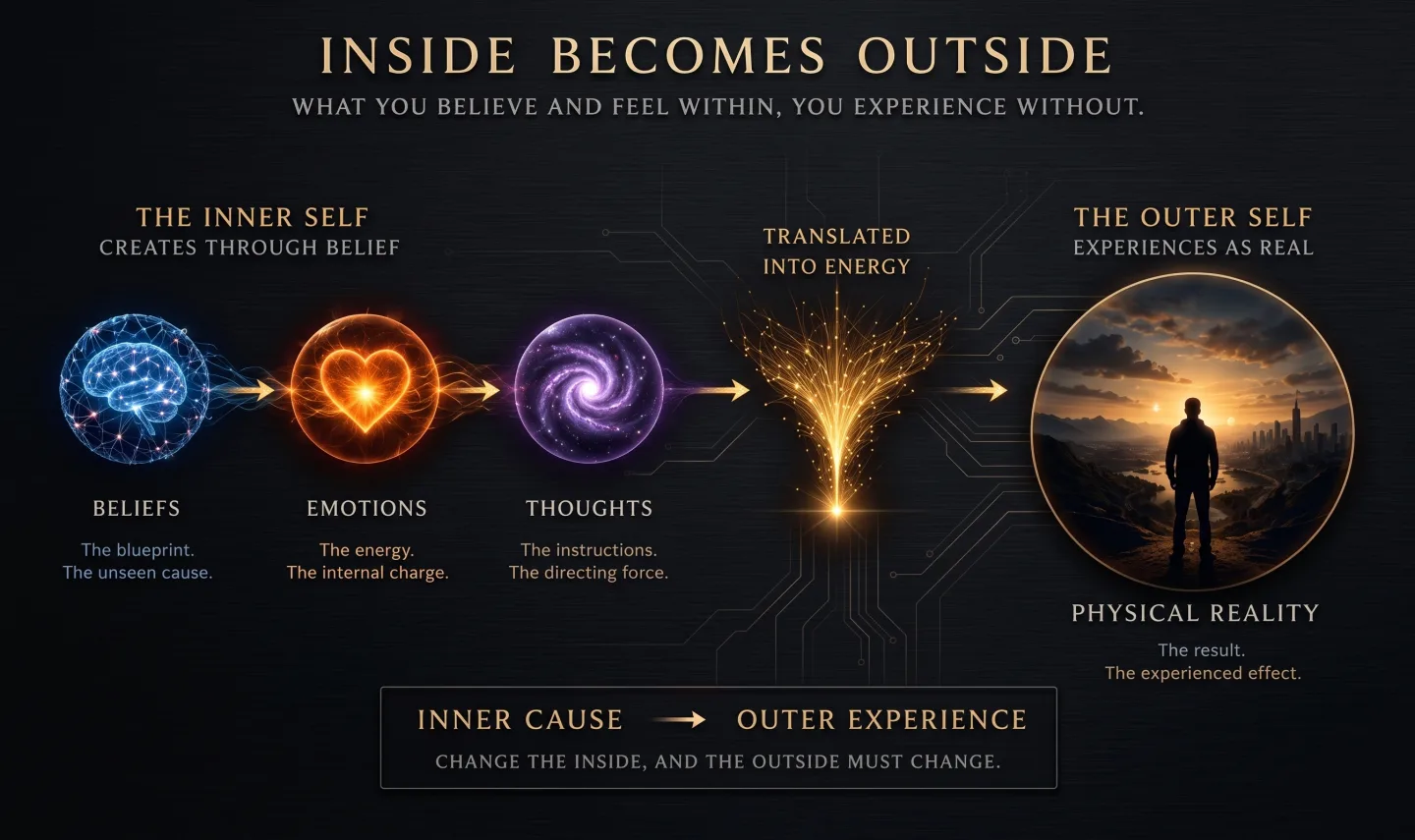
Inside becomes outside. Goddard's claim as a pipeline: belief is the blueprint, emotion the charge, thought the instruction, physical reality the result. It's the two planes from Principle 06 turned on their side. Watch the word must in the last line; the next paragraph is about that word. AI-generated illustration, not a redrawing.
"Assumption hardens into fact" is Mentalism you can actually run this week — which puts it in the same small club as Care. It also inherits the same flaw as "chance is but a name for Law not recognized": when the assumption doesn't crystallize, the system says you didn't assume hard enough. A test you cannot fail is not a test. I find the practice interesting and the immunity to failure suspicious, and I'm holding both of those at once.
Still working
Open questions
Read the source, not the summaries.The Kybalion is short and public domain. The original wording of 1–7 is more careful than most of what's built on top of it.
Where does this stop being descriptive and start being unfalsifiable? "Chance is but a name for Law not recognized" is unanswerable by construction — any counterexample becomes a law you haven't found yet. That's a feature for a worldview and a bug for a claim.
The two-planes model is the strongest practical piece so far. It's a clean reframe of something ordinary — stop debugging symptoms — into something you'll actually remember.
Care is the one with teeth because it's the only one that generates a test you can fail this week.
The resonance–kurtosis mirror is a rhyme, not an identity. Both are peaked curves, and "frequency" appears in both vocabularies — but a shared curve shape and a shared word don't make the two systems the same system. Useful as a lens; suspect as a claim.
Open: how much of the appeal here is the ideas, and how much is that they're delivered as ancient secrets? Worth separating before I lean on any of it.
Provenance. Notes taken from a lecture presentation of the eight principles, checked against The Kybalion (1908) for the classical seven. Parts Three through Five also draw on lecture material connecting resonance to statistics, Michio Kushi's Freedom From Delusions lecture (1984), and Neville Goddard's God And I Are One lecture (1972). No slide images or video frames are reproduced here — every figure is my own redrawing, in this site's style, of an idea from the source material, and the idea's origin is credited in its caption. The one exception is the "Inside becomes outside" illustration in Part Five, which is AI-generated and labelled as such. The wording of each axiom is quoted because it's the part that matters.
Status. Learning in public, revised as I go. Nothing here is a position I'm defending.